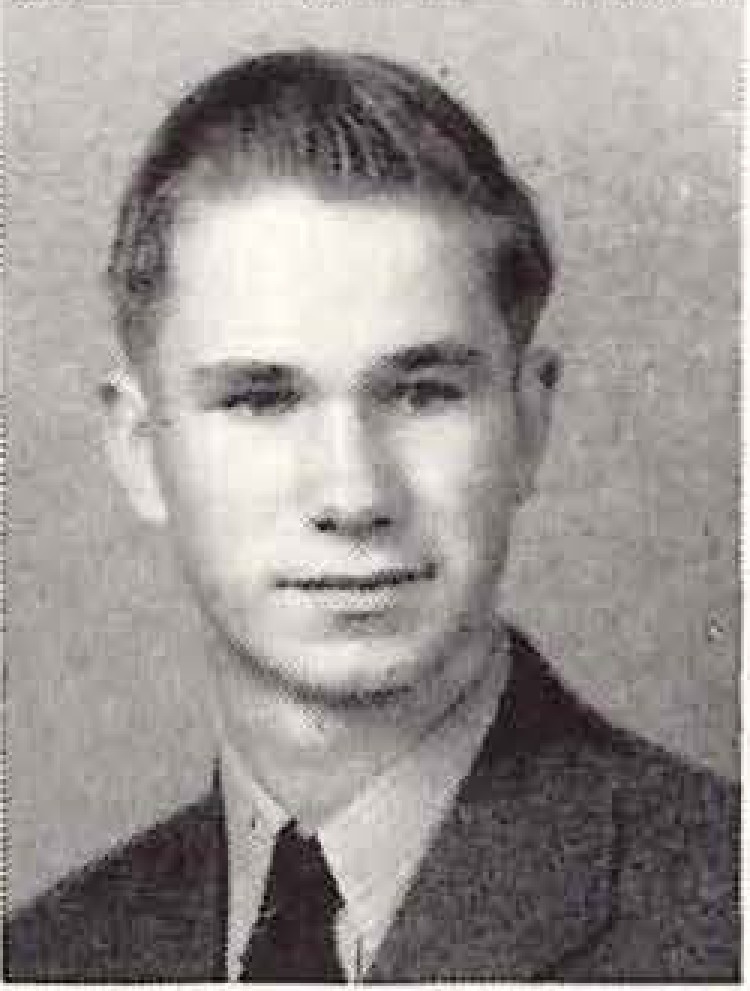
Portrait of Harold John Nelson in uniform
A World War II Service Record

Harold John Nelson

Technician Fifth Grade (T/5) · 161st Infantry Regiment, 25th Infantry Division
Army · Service no. 39 479 614
Service Number
39 479 614
Later rank (family record)
Technician Fifth Grade (T/5)
Confirmed unit (Apr 1945)
161st Infantry Regiment, 25th Infantry Division
MOS
Mail Orderly (055)
Theater
Asiatic-Pacific Theater (APO)
This timeline reconstructs Harold's World War II service from the Honorable Discharge and branch-appropriate National Archives unit records, searched by service number. Each entry cites its source; items marked Newly discovered were recovered from the records.

Map of Service

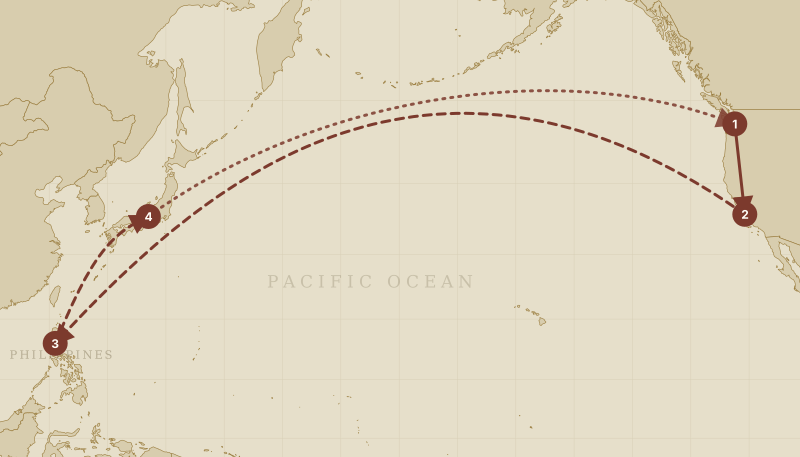
Route reconstructed from confirmed locations.

Map of Harold John Nelson's documented WWII service route

Service stops

  1. Seattle / Fort Lewis, Wash.inducted 9 Aug 1944; reception center the same evening
  2. Camp Roberts, Cal.infantry training, 21 Aug - 16 Dec 1944
  3. Luzon, P.I.Luzon campaign; in combat by 1 Apr 1945
  4. Japanoccupation duty, 1945-46

Route notes

  • 1 → 2Ordered 14 Aug 1944 by Special Orders No. 194
  • 2 → 3Sailed 25 Jan 1945; in theater 26 Feb 1945
  • 3 → 4Occupation duty
  • 4 → 1Left the theater 13 Aug 1946; home 26 Aug 1946
First time here?

How to read this service timeline

This page brings together records created for different purposes. The labels below tell you what kind of evidence supports each entry; open either guide when a record or military term is unfamiliar.

Confirmed — Discharge

A personal military record supports the entry.

Confirmed — Unit record

A record created by his unit names him or documents the unit’s activity.

Context

Helpful background, clearly separated from personal evidence.

Newly discovered

Information recovered during this research, rather than supplied at the start.

How to read a Morning Report

Morning Reports were daily administrative records prepared by individual Army and Army Air Forces units. They generally recorded changes—such as arrivals, transfers, promotions, illness, or return to duty—not a complete list of everyone present.

MORNING REPORT · SAMPLE
1Organization
Company A, 123rd Infantry
2Station or location
Camp Example, Virginia
3Date
14 September 1944
4Section
Personnel changes
5Pvt Smith, John A., 35123456
6asgd fr Hq Co per SO 187, Hq 123d Inf
In plain English Private John A. Smith, identified by Army Serial Number 35123456, was assigned to Company A from Headquarters Company under Special Orders No. 187.
  1. 1Organization: the company, hospital, squadron, or other unit filing the report.
  2. 2Station or location: where that unit reported from on that date.
  3. 3Report date: the date of the report, which may differ from the effective date of a change.
  4. 4Section: the part of the form containing personnel changes or the unit’s record of events.
  5. 5Soldier entry: usually rank, name, and Army Serial Number.
  6. 6Change and authority: what happened and the order authorizing it.
asgd
assigned
atchd
attached
trfd
transferred
fr
from
aptd
appointed
EM
enlisted men
SO
Special Orders
GO
General Orders
orgn
organization
sta
station
Common military and research terms
Army Serial Number (ASN)
The unique service number used to distinguish one soldier from others with similar names.
Discharge or separation paper
The document issued when a service member left active service. For many WWII Army enlisted soldiers, this is WD AGO Form 53-55. It summarizes service but is not a day-by-day history.
Morning Report
An Army unit’s daily administrative report. It usually lists people whose status changed, not every person in the unit.
Unit record
A document created by a military organization. It may name the soldier directly or provide context about his unit; the timeline states which applies.
OMPF or “201 file”
The service member’s Official Military Personnel File. Many Army and Air Force files were damaged or destroyed in the 1973 National Personnel Records Center fire.
Unit and final unit
A unit is the organization in which someone served. The final unit is the organization shown at separation; it may not be the only unit in the service history.
Rank or grade
The service member’s level in the military hierarchy. A timeline may show changes in rank over time.
MOS
Military Occupational Specialty—the Army’s classification for a soldier’s primary military job.
Assigned and attached
Assigned means formally placed in a unit. Attached usually means serving with a unit temporarily while belonging administratively elsewhere.
Special Orders and General Orders
Official directives used to authorize personnel actions, awards, organizational changes, and other decisions.
Campaign credit
Official recognition for service connected with a named campaign. It does not, by itself, describe a service member’s individual actions.
Station or location
The place from which a unit filed a report. It does not automatically prove that every member was physically present there.
Source citation
The note beneath a timeline entry identifying the record or records that support it.
Service Timeline

24 min
Confirmed — Record
March 21, 1926

Born in Medina, King County, Washington

Harold was born on 21 March 1926 in Medina, Washington, on the eastern shore of Lake Washington. His Social Security application, filed in February 1943 when he was sixteen, gives his middle name, John, and his parents’ names: Nels C. Nelson and Nina Neil. The 1950 census adds their birthplaces: his father in Wisconsin, about 1875, and his mother in Minnesota, about 1886.
Confirmed — Record
1942 – 1943

Aircraft spotter on the home front

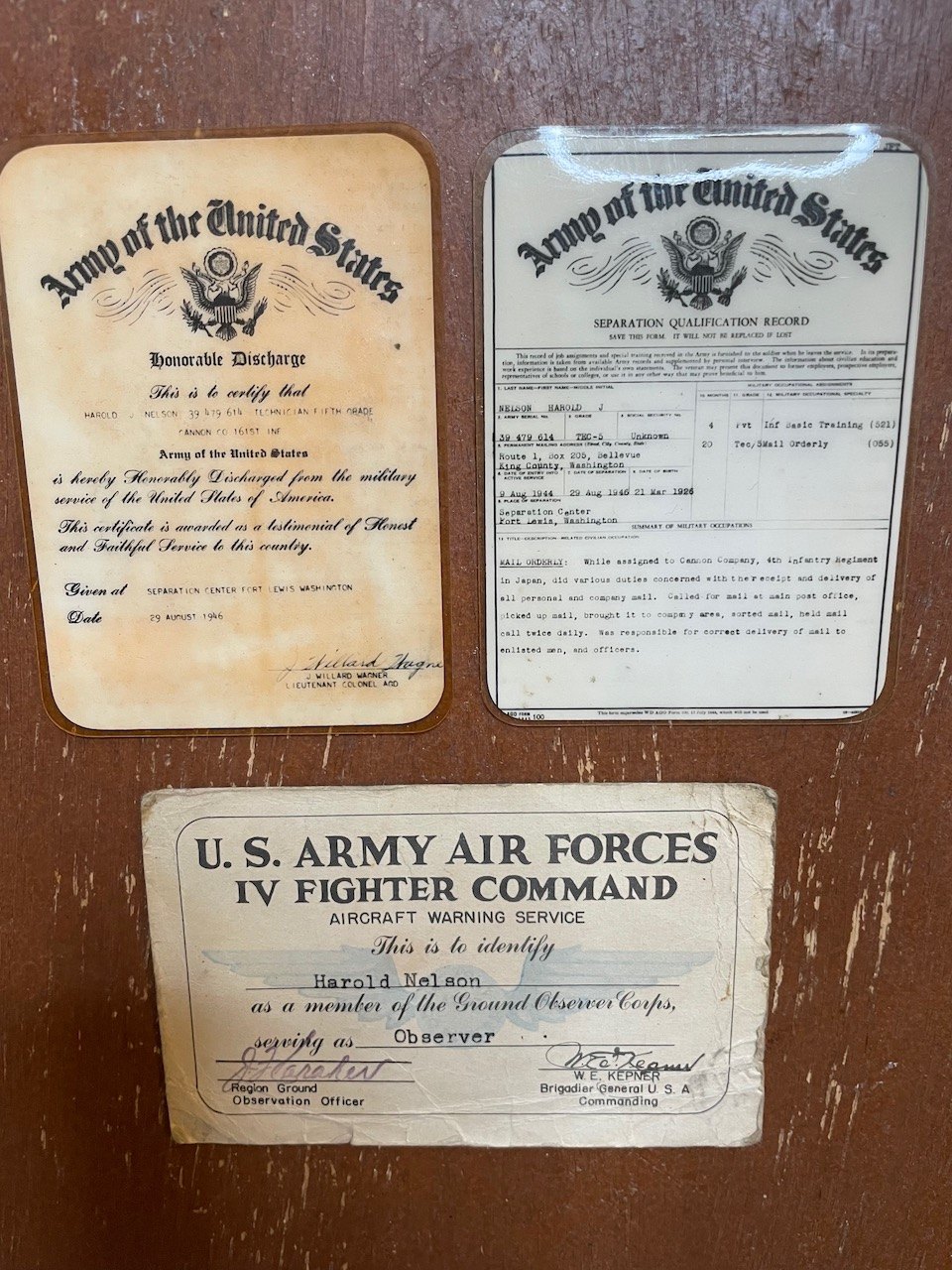
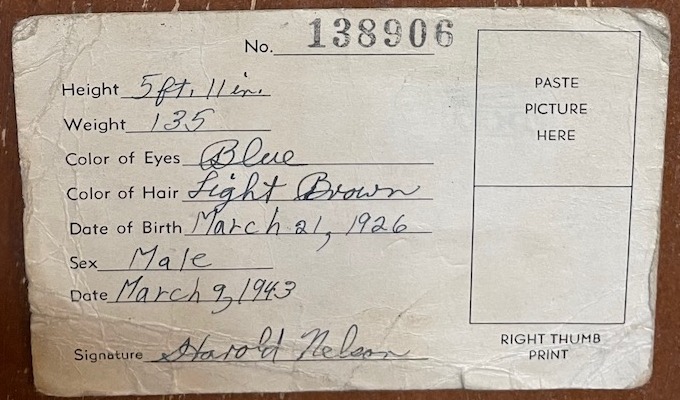
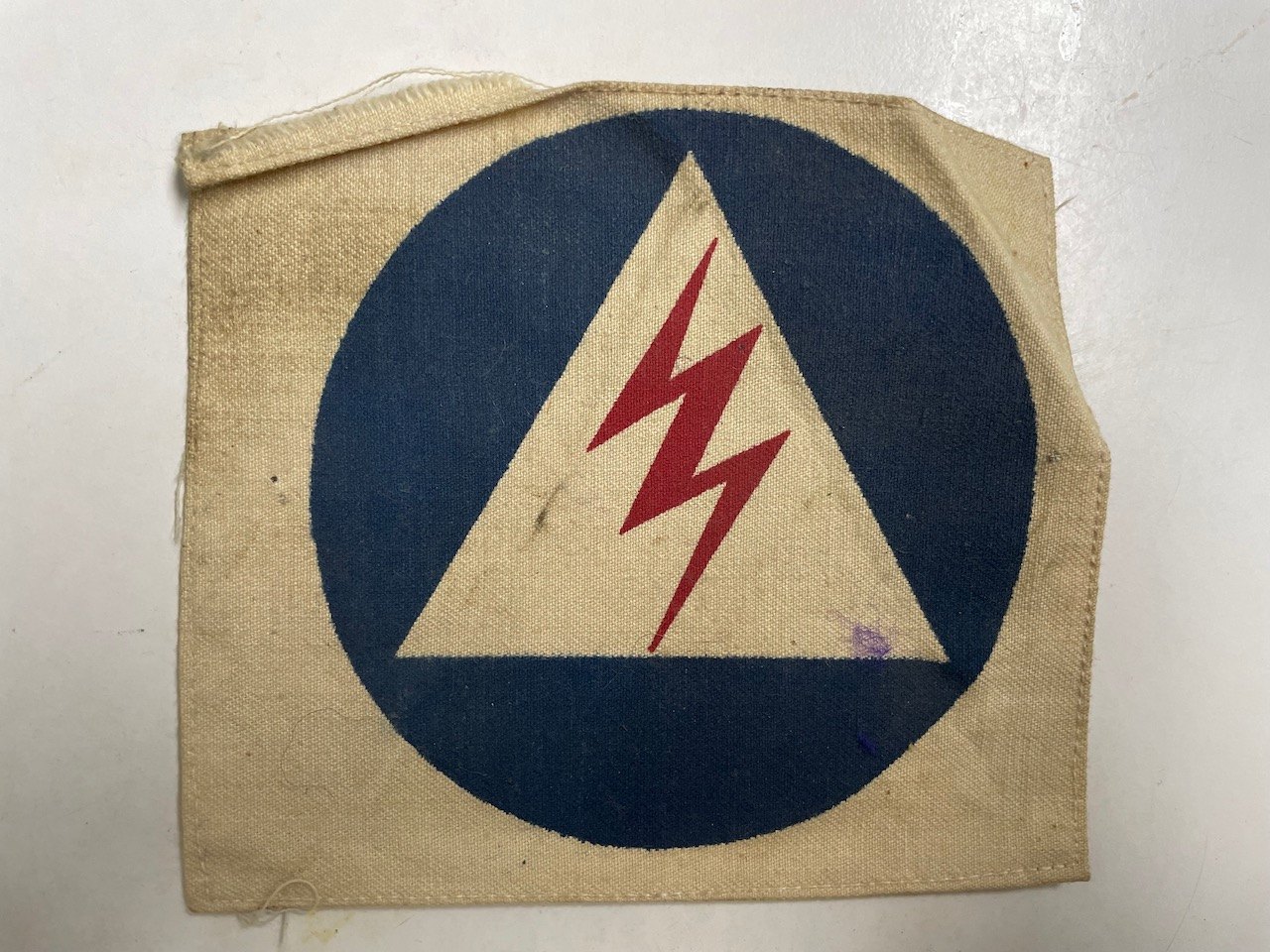
Before he was old enough for the Army, Harold was a volunteer aircraft observer. He carried a card from the U.S. Army Air Forces, IV Fighter Command, Aircraft Warning Service identifying him as a member of the Ground Observer Corps, serving as Observer. The Ground Observer Corps was the civilian volunteer network that watched the sky for aircraft and reported what it saw; on the West Coast it came under IV Fighter Command, which had a fighter wing based at Seattle. The card carries the signature of Brigadier General William E. Kepner, who commanded IV Fighter Command from February 1942 until 18 March 1943, and later that year took command of VIII Fighter Command in England. Framed with it is an identification card, no. 138906, dated 9 March 1943, when Harold was sixteen. It describes him as five feet eleven, 135 pounds, with blue eyes and light brown hair, and is signed “Harold Nelson.” It does not name the agency that issued it. The family also kept a civil defense Messenger insignia from the Citizens Defense Corps. This was volunteer civil-defence work, not military service. Which observation post he served at is not recorded.
scanned record
His Ground Observer Corps card.
scanned record
Identification card no. 138906, dated March 9, 1943 on the bottom line and signed “Harold Nelson.” It is framed with the observer card but does not name who issued it.
scanned record
The Citizens Defense Corps Messenger insignia the family kept. The red lightning flash marked the Messenger Corps.
Source: His Ground Observer Corps card, U.S. Army Air Forces IV Fighter Command, Aircraft Warning Service, signed W. E. Kepner, Brigadier General, Commanding (undated); and identification card no. 138906, dated 9 March 1943, which names no issuing agency. Both held by the family. Kepner's commands from his official U.S. Air Force biography, https://www.af.mil/About-Us/Biographies/Display/Article/106566/william-e-kepner/; the Ground Observer Corps from Wesley Frank Craven and James Lea Cate, The Army Air Forces in World War II, vol. I, ch. 8, https://www.ibiblio.org/hyperwar/AAF/I/AAF-I-8.html, and vol. VI, p. 93 (the Seattle wing); the Messenger insignia from the Office of Civilian Defense's official insignia, 1941, https://commons.wikimedia.org/wiki/File:United_States_Civilian_Defense_Insignia_-_Messenger_Corps.svg
Confirmed — Record
Spring 1943

On the Overlake baseball team

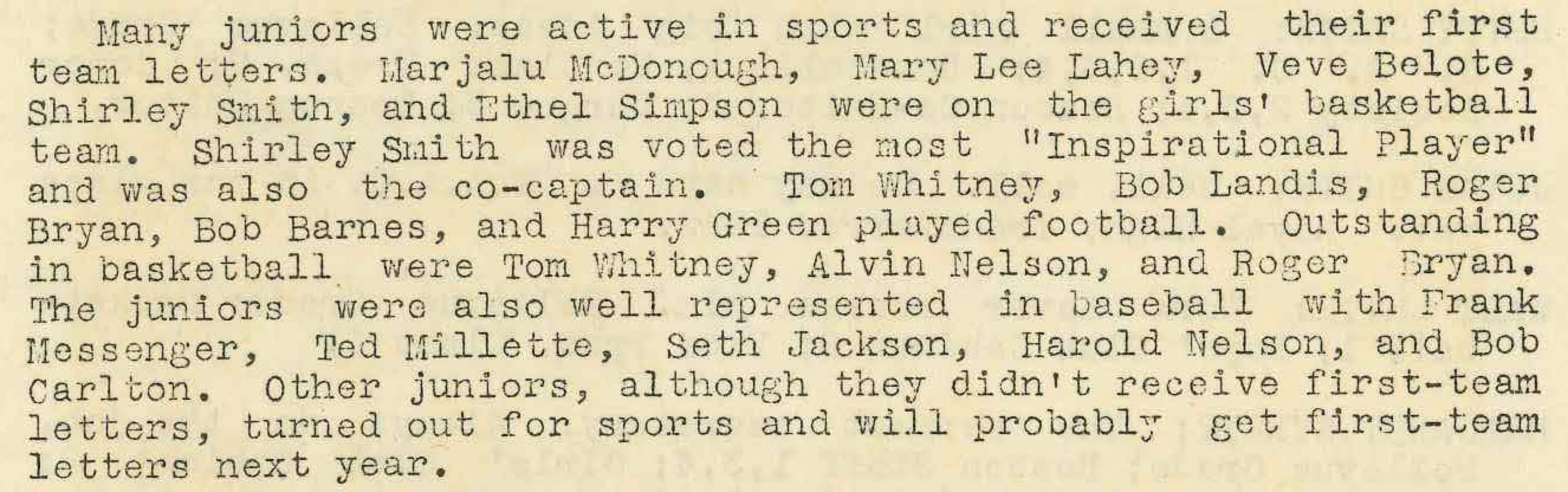
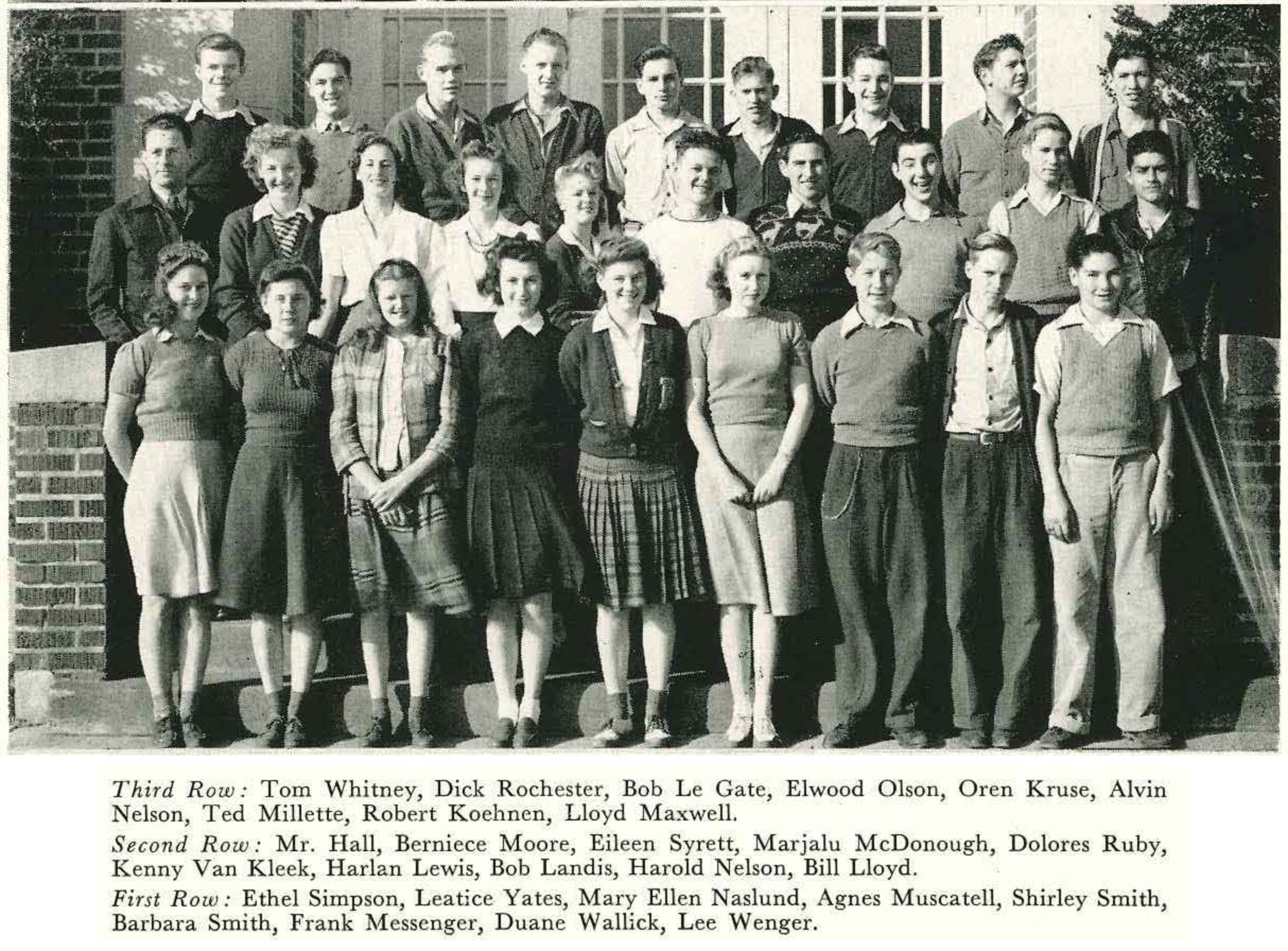
He came to Overlake High School in Bellevue for his junior year, transferring in from Kirkland High. That spring the school yearbook names him among the juniors on the baseball team, in a paragraph about first-team letters: “The juniors were also well represented in baseball with Frank Messenger, Ted Millette, Seth Jackson, Harold Nelson, and Bob Carlton.” He was seventeen. He is also in the junior class photograph that year, ninth from the left in the second row.
scanned record
The Junior Class page of the 1943 Beacon.
scanned record
The juniors in the 1943 Beacon. Harold is ninth from the left in the second row.
Source: The Beacon, Overlake High School, Bellevue, Washington, 1943, published by the Bellevue School District, https://bellevuehigh.bsd405.org/resources/library/yearbook-archive
Confirmed — Record
March 24, 1944

Registered for the draft

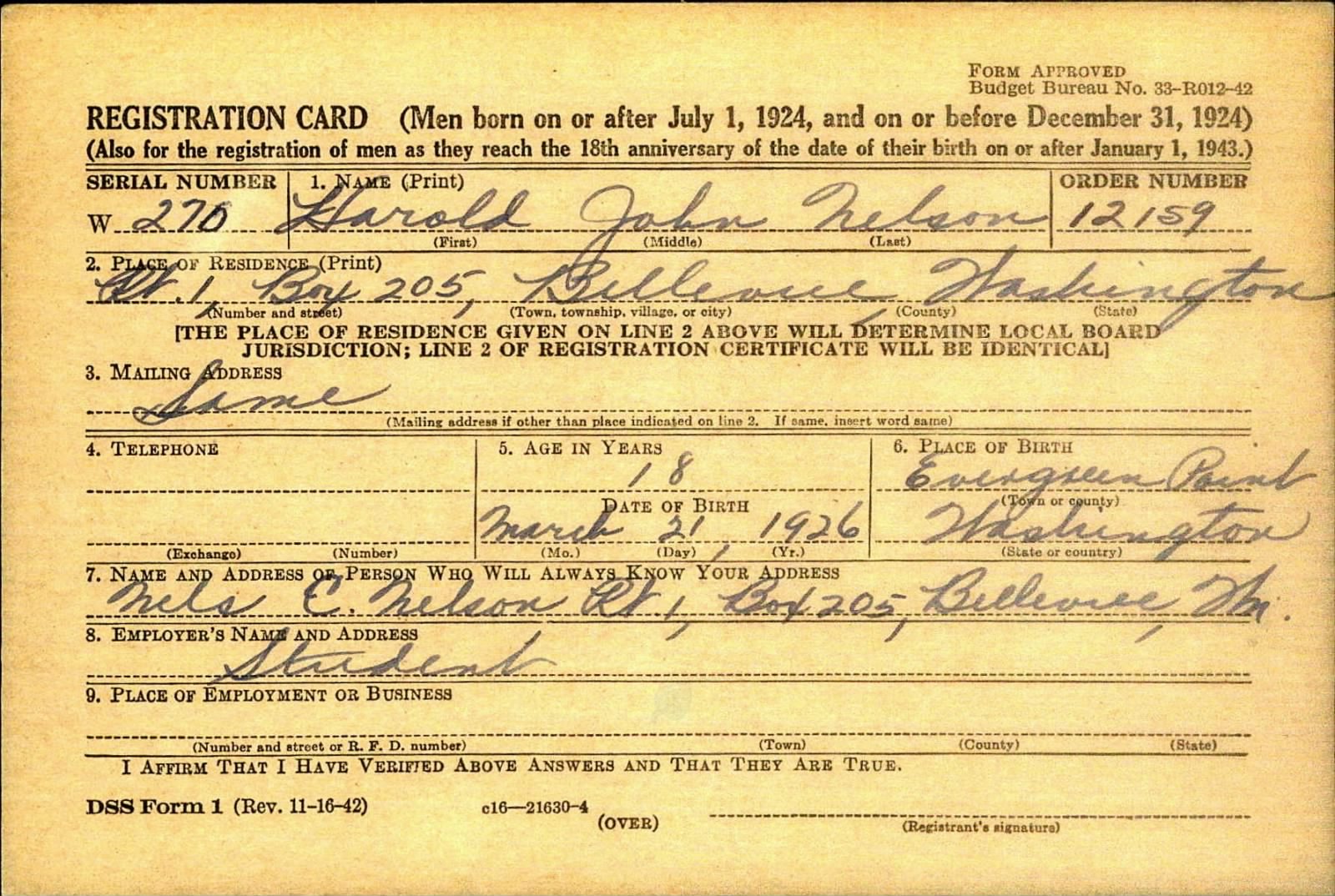
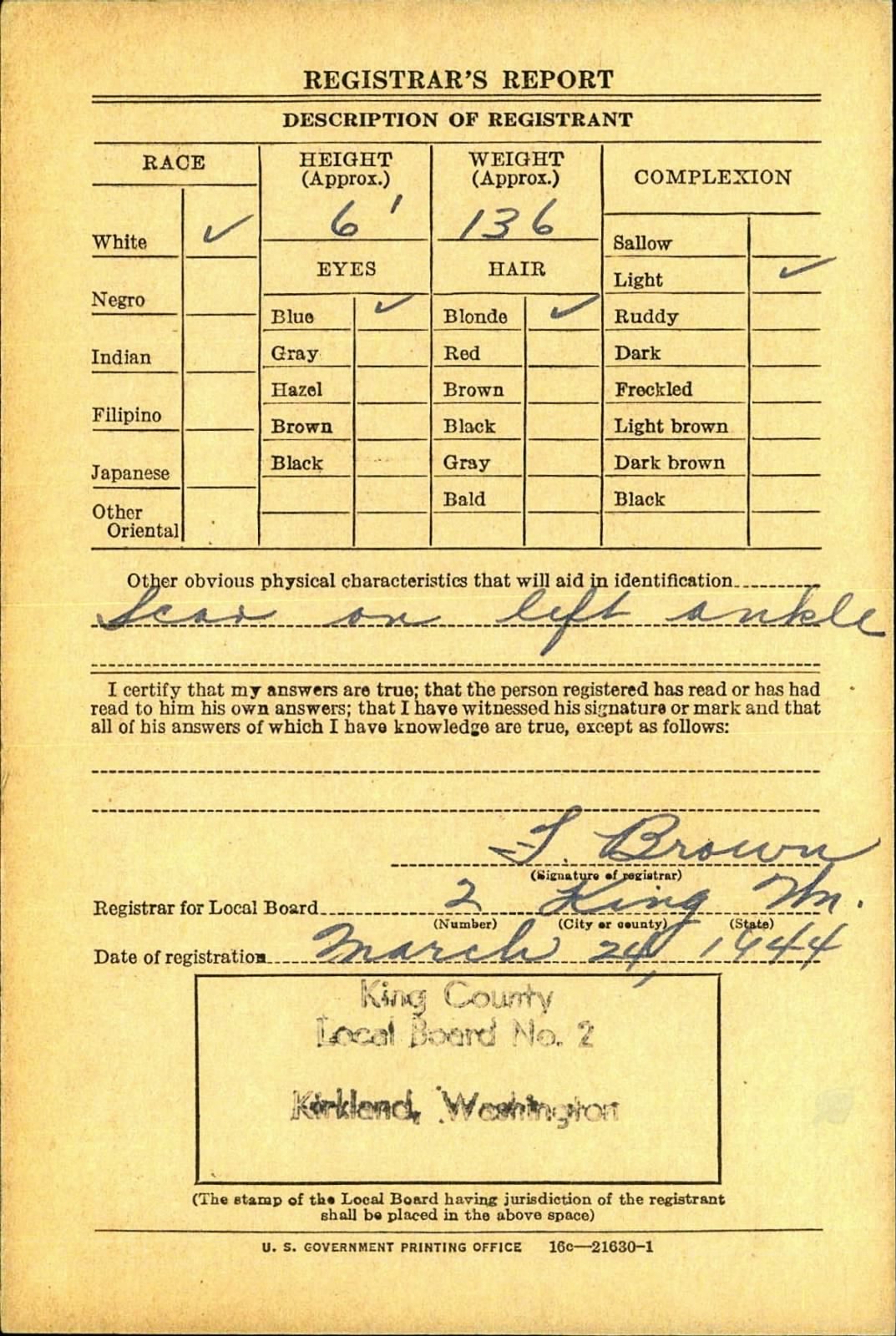
Three days after his eighteenth birthday, Harold registered with King County Local Board No. 2 at Kirkland. His card gives his address as Route 1, Box 205, Bellevue, and under employer it says “Student.” As the person who would always know his address he named his father, Nels C. Nelson, at the same house. The registrar described him as six feet tall and 136 pounds, with blue eyes, blond hair, a light complexion and a scar on his left ankle. The card gives his birthplace as Evergreen Point. His discharge says Medina, which runs from Evergreen Point south to Meydenbauer Bay. The order number at the top of the card, 12159, is the one on the Selective Service form he filled out in September 1946.
scanned record
The front of his draft registration card, 24 March 1944.
scanned record
The back: the registrar’s description of him and the stamp of King County Local Board No. 2, Kirkland.
Source: Selective Service registration card (DSS Form 1) and registrar’s report, Harold John Nelson, order no. 12159, King County Local Board No. 2, Kirkland, Washington, 24 March 1944. U.S. WWII Draft Registration Cards, 1940–1947, Fold3, https://www.fold3.com/publication/816/us-wwii-draft-registration-cards-1940; original at the National Archives at St. Louis, Records of the Selective Service System (RG 147). Order number matched to his Selective Service D.S.S. Form 14, 6 September 1946. Medina’s extent from HistoryLink, https://www.historylink.org/File/1059
Confirmed — Record
1944

Graduates from Overlake High School

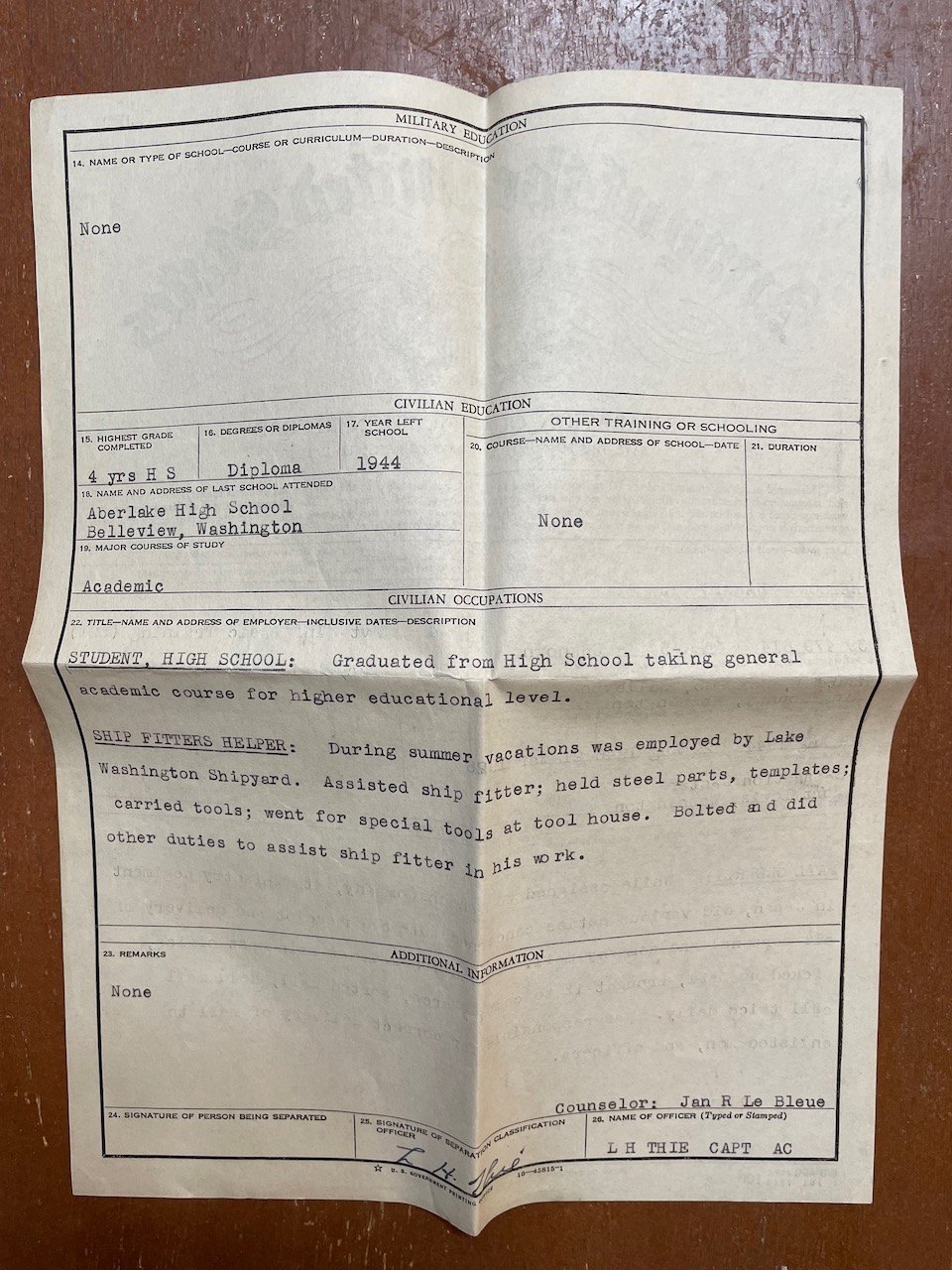
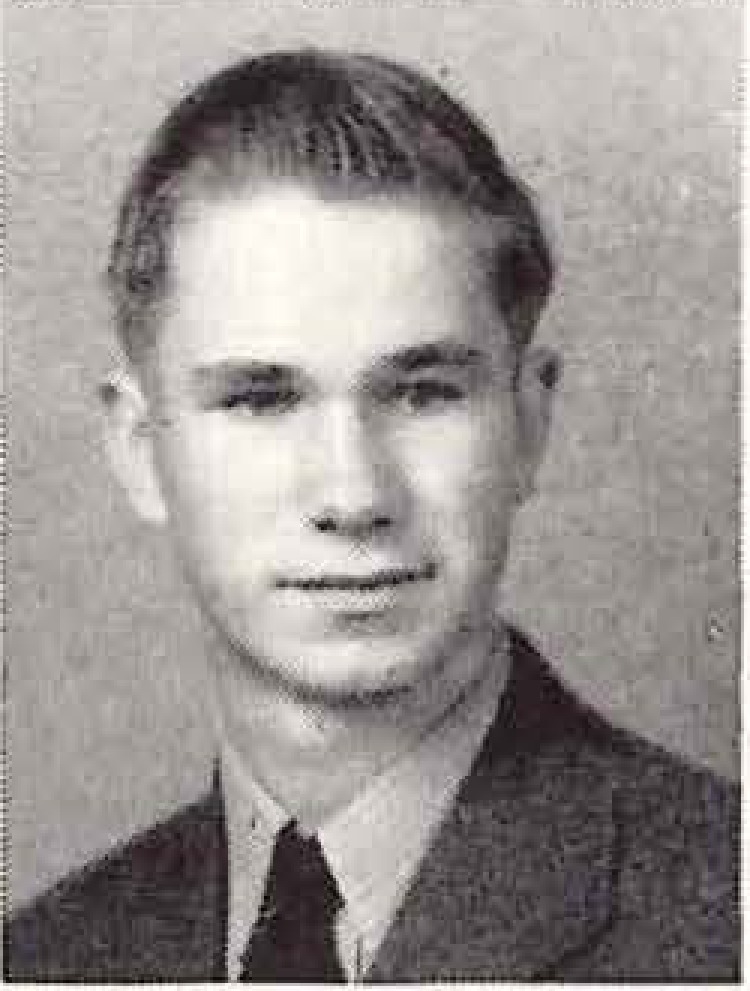
This is his yearbook photo, from The Beacon, the 1944 yearbook of Overlake High School in Bellevue — the school his separation papers name, where the typist rendered it “Aberlake High School, Belleview.” His entry in the book runs to a single line: “HAROLD NELSON. ‘Nels’; Kirkland High 3; Scientific; Football 4; Baseball 3, 4; Basketball 4.” It gives his nickname, the scientific course, and three sports in his senior year. His separation papers record four years of high school and a diploma in 1944. The other line under civilian occupations is the one that had him doing war work before he ever wore a uniform: ship fitter’s helper at the Lake Washington Shipyard, in the summer holidays. The yard was at Houghton, across the lake at what is now Carillon Point, and it had gone from a few hundred workers before the war to more than eight thousand on three shifts, building twenty-nine ships for the Navy and repairing several hundred more. His own description of the work, taken down at his separation interview, is plain enough: “Assisted ship fitter; held steel parts, templates; carried tools; went for special tools at tool house. Bolted and did other duties to assist ship fitter in his work.”
scanned record
His senior portrait in the 1944 Overlake High School yearbook. He was inducted that August.
scanned record
His entry among the seniors in the 1944 Beacon.
scanned record
The inside of his Separation Qualification Record: four years of high school, a 1944 diploma, and the shipyard job in his own words.
Source: Separation Qualification Record (WD AGO Form 100), civilian education and civilian occupations. The school district's own timeline for the Overlake name, https://static1.squarespace.com/static/5b735a34c258b4b0a11bec80/t/5b737693b8a04507b75d3bc4/1534293652124/BellevueSchoolsTimeline+1883-Present.pdf; the shipyard from HistoryLink, https://www.historylink.org/File/20514, and the Kirkland Heritage Society, https://kirklandheritage.org/lakewashingtonshipyards/. His portrait and his class entry from The Beacon, Overlake High School, 1944, published by the Bellevue School District, https://bellevuehigh.bsd405.org/resources/library/yearbook-archive
Confirmed — Unit record
August 9, 1944

Inducted at Seattle; at Fort Lewis the same day

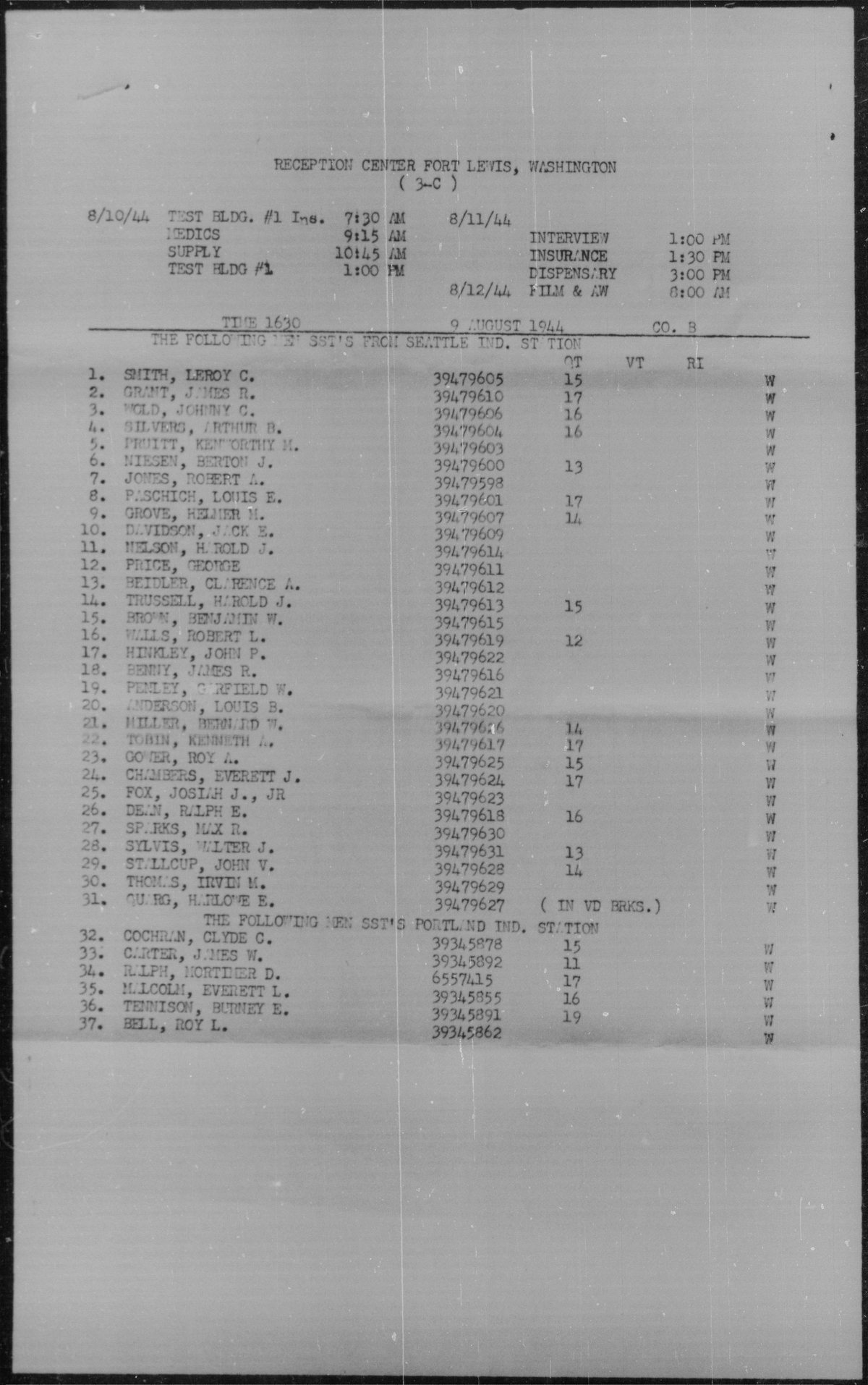
His discharge gives 9 August 1944 as the day he was inducted at Seattle and entered active service. The page below is from the Reception Center at Fort Lewis and carries the same date, with the time 1630 hours: a Company B list of men from the Seattle Induction Station. Harold is 11th on the list: “NELSON, HAROLD J. — 39479614”. The same sheet gives the group’s schedule for the next three days — testing and medics on the 10th, interview, insurance and dispensary on the 11th, film and the Articles of War on the 12th.
scanned record
The Fort Lewis arrival list, 9 August 1944. His name is line 11. The yellow is ours — it marks his name and service number on the sheet.
Source: Morning Report — Reception Center, Fort Lewis, Washington — NARA Roll 87 (NAID 564687438), image 311 (page 312 of NARA's extracted text) (August 1944) — induction date and place from his Honorable Discharge (WD AGO Form 53-55), items 22, 24 and 25, corroborated by his VA BIRLS record
Confirmed — Unit record
August 14, 1944

Ordered to Camp Roberts, California

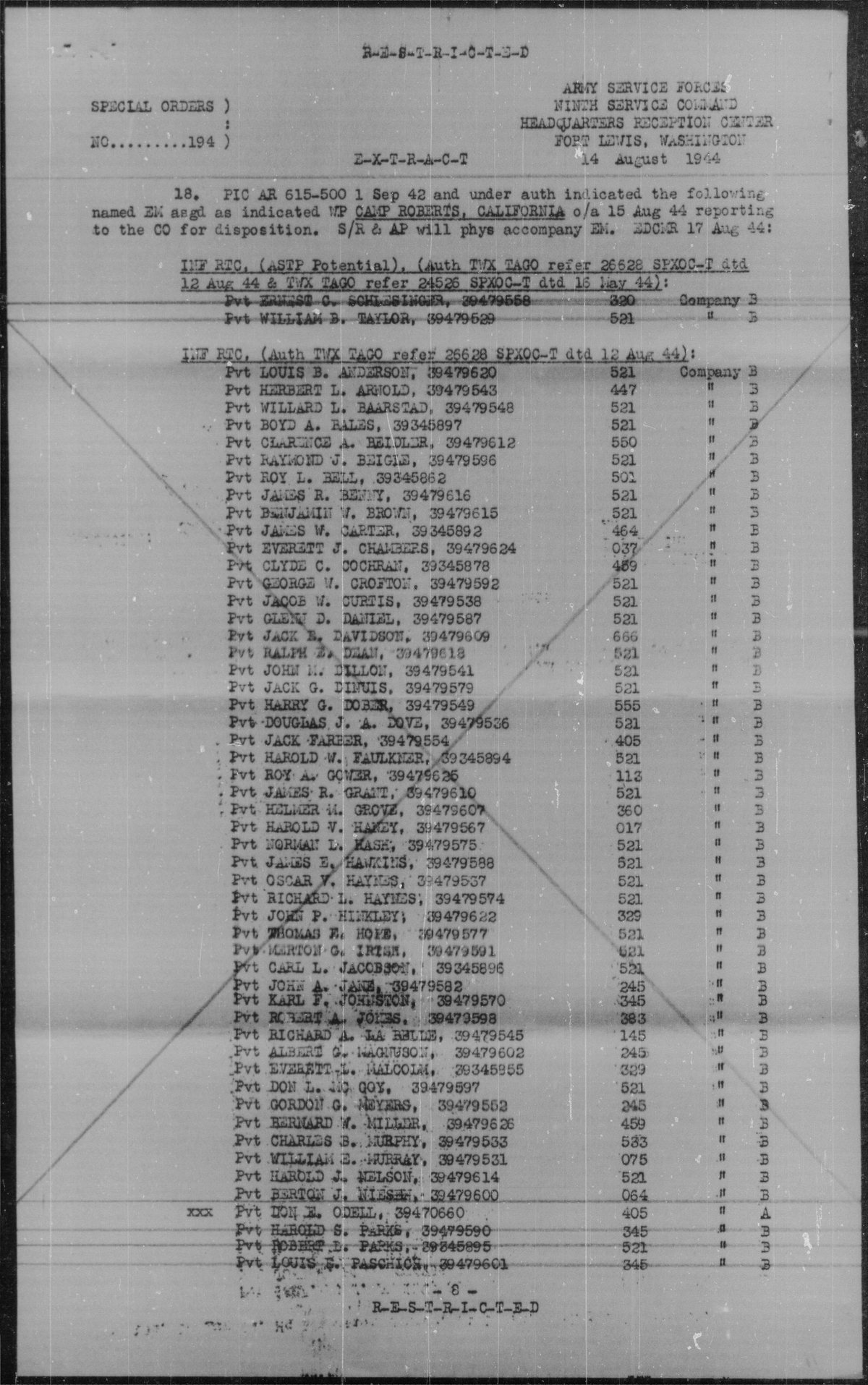
Special Orders No. 194, Headquarters Reception Center, Fort Lewis, paragraph 18, sends a long column of new soldiers to the Infantry Replacement Training Center at Camp Roberts, California, to leave on or about 15 August. His line reads “Pvt HAROLD J. NELSON, 39479614”. Five days after his induction, the Army had assigned him to infantry training.
scanned record
Special Orders No. 194, 14 August 1944, paragraph 18. The yellow is ours — it marks his name and service number on the sheet.
Source: Morning Report — Headquarters Reception Center, Fort Lewis, Washington — NARA Roll 87 (NAID 564687438), image 118 (text page 119; further filed copies of the order at text pages 133, 373 and 399) (August 1944)
Confirmed — Unit record
August 19, 1944

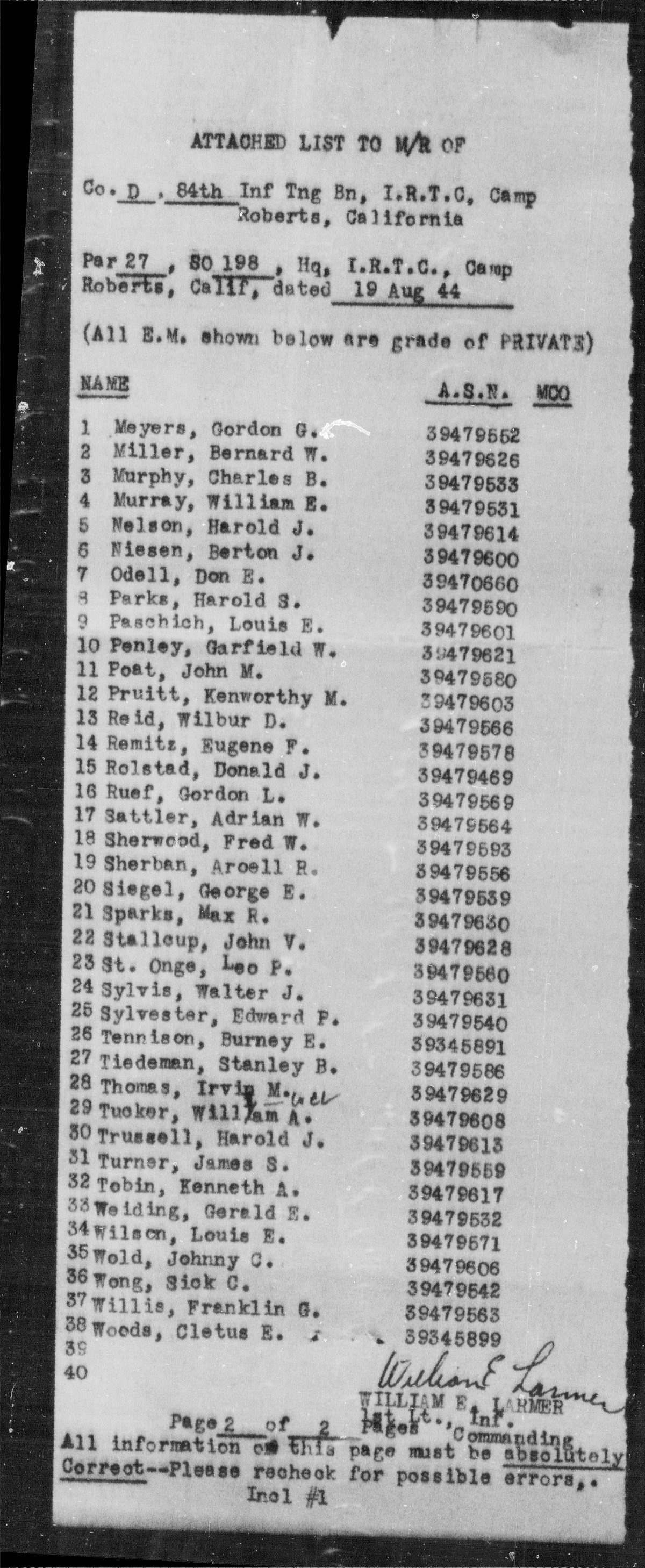
Company D, 84th Infantry Training Battalion — Camp Roberts

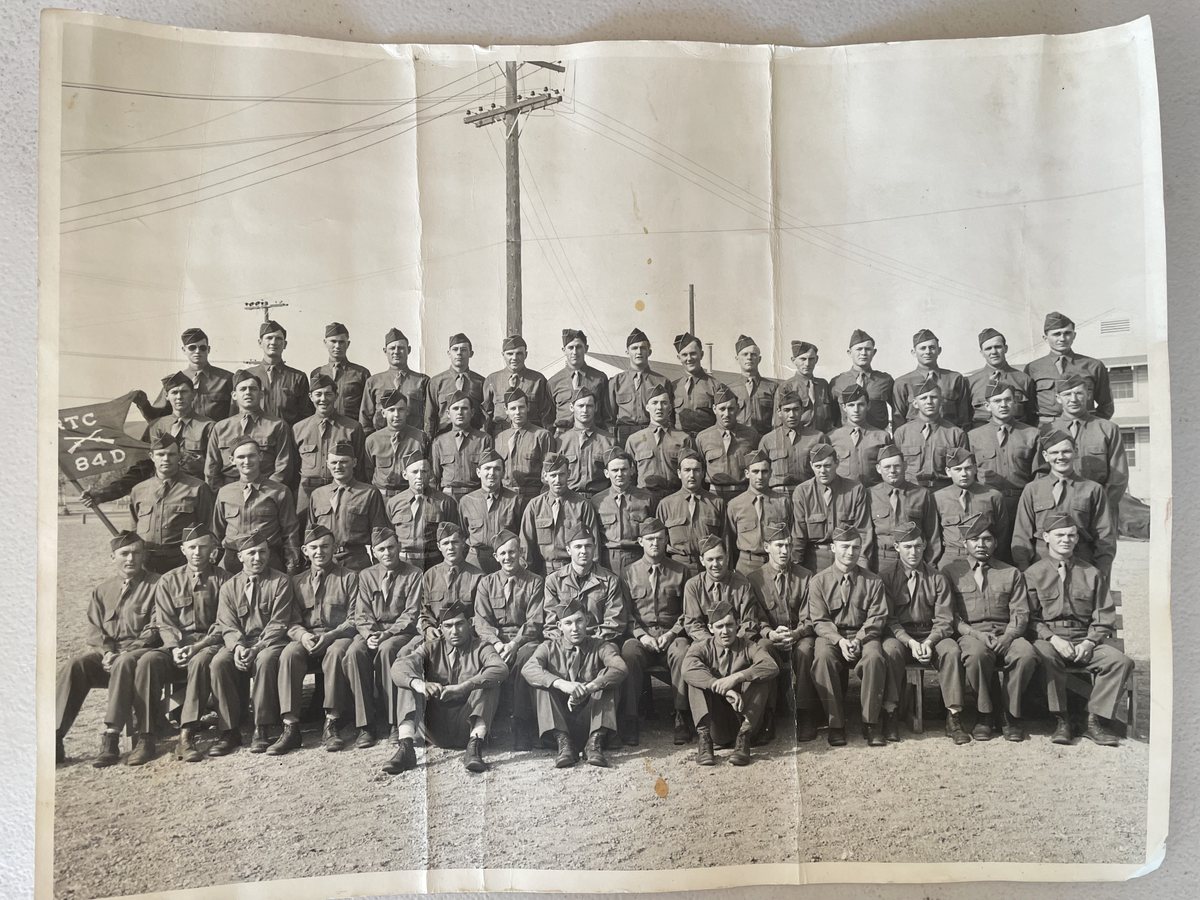
A list attached to the company’s Morning Report puts him in Company D, 84th Infantry Training Battalion at Camp Roberts. Line 5: “Nelson, Harold J. — 39479614”. Every man on the sheet is a private. The company’s report for 19 August records the 78 men on the list as attached and joined on 17 August 1944. Army replacement training centers used a standard seventeen-week infantry cycle during this period. The family kept a group photograph of a training company whose guidon shows the crossed rifles of the infantry, 84 D, and the letters RTC. That matches his company, but the photograph has no date and no names, so it cannot be tied to his training cycle.
scanned record
The attached list of 19 August 1944. His name is line 5. The yellow is ours — it marks his name and service number on the sheet.
scanned record
The family's photograph of a training company, guidon at left marked with the crossed rifles and 84 D. It is undated and names no one.
Source: Morning Report — Company D, 84th Infantry Training Battalion, IRTC, Camp Roberts — NARA Roll 392 (NAID 565659965), image 1680 (text page 1681; the company's report of 19 August is image 1675) (August 1944) — training-cycle detail from the Army of the United States Station List, 7 April 1945, and Robert W. Coakley and Richard M. Leighton, The Personnel Replacement System in the United States Army (U.S. Army Center of Military History), pp. 357–358
Confirmed — Unit record
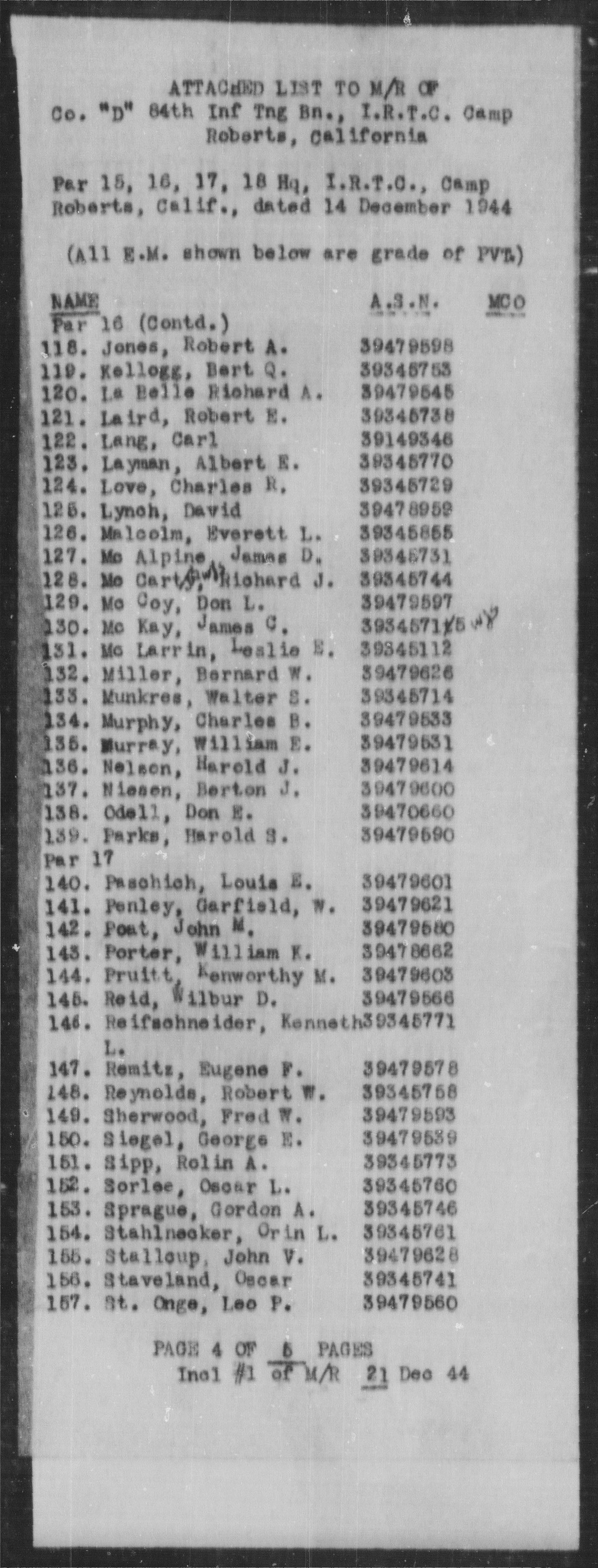
December 14, 1944

Still at Camp Roberts, still a private

Four months on, the same company’s attached list carries him again at number 136 — “Nelson, Harold J. — 39479614” — and every man on it is still graded private. Two days later his seventeen-week course ended, and about six weeks after that he left the United States.
scanned record
The attached list of 14 December 1944. His name is line 136. The yellow is ours — it marks his name and service number on the sheet.
Source: Morning Report — Company D, 84th Infantry Training Battalion, IRTC, Camp Roberts — NARA Roll 288 (NAID 578009449), image 1305, with a second filed copy at image 1313 (text pages 1306 and 1314) (December 1944)
Confirmed — Discharge
December 16, 1944

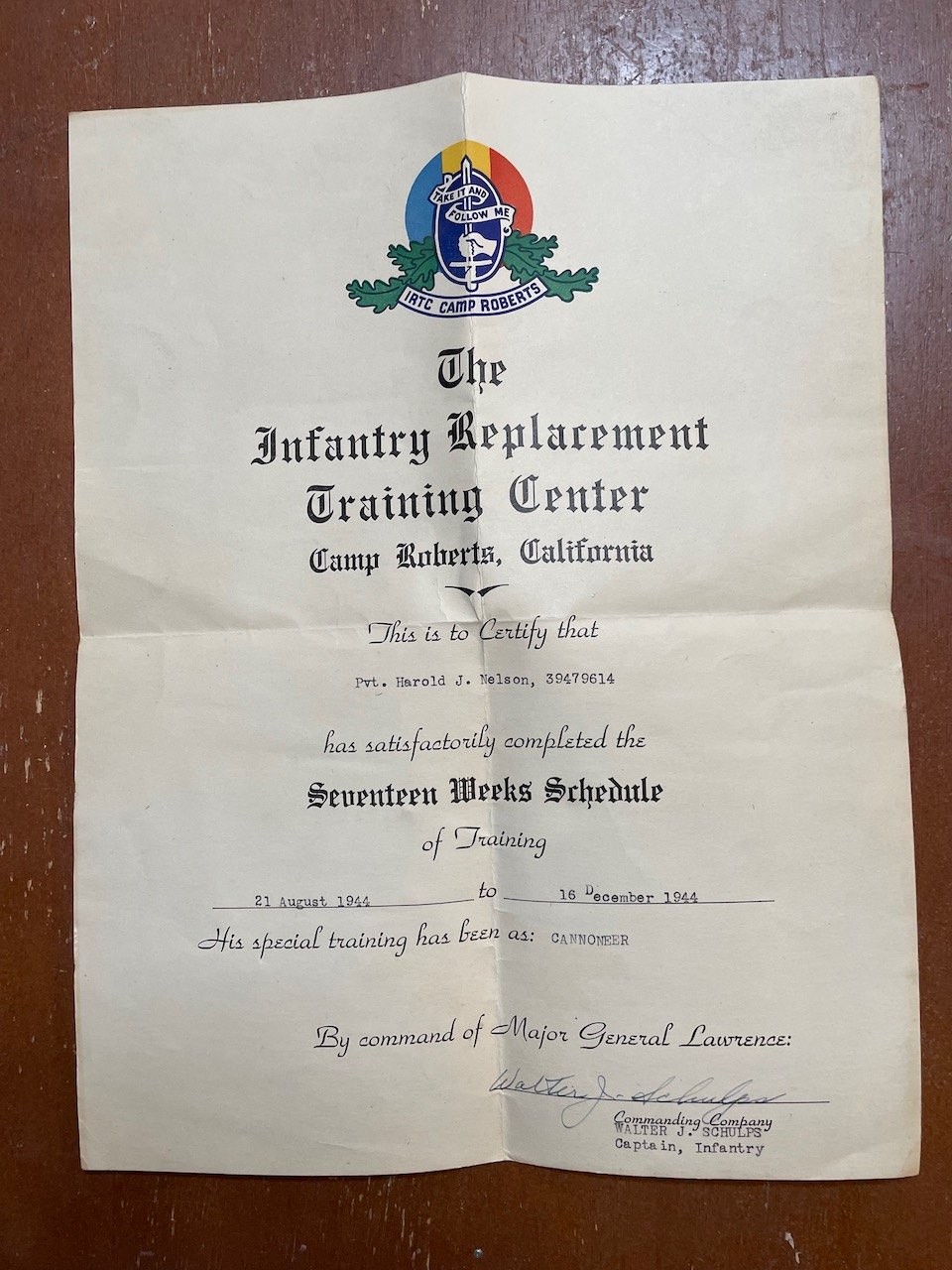
Finished infantry training — trained as a cannoneer

His certificate from the Infantry Replacement Training Center records that Pvt. Harold J. Nelson, 39479614 satisfactorily completed the seventeen weeks schedule of training, 21 August to 16 December 1944. Under “His special training has been as” the clerk typed one word: CANNONEER. In the Army’s table for an infantry regiment’s Cannon Company, each 105mm howitzer section had ten men: a chief of section, a gunner, seven cannoneers and a driver. By the following April he was serving in a Cannon Company.
scanned record
His Camp Roberts certificate: seventeen weeks, and the word CANNONEER.
Source: Infantry Replacement Training Center, Camp Roberts, California — certificate of training, 21 August to 16 December 1944 (the certificate itself is undated), signed Walter J. Schulps, Captain, Infantry, Commanding Company. Held by the family. Gun-crew composition from War Department Table of Organization and Equipment 7-14, 26 February 1944
Confirmed — Unit record
December 21, 1944

Sent to the replacement depot at Fort Ord

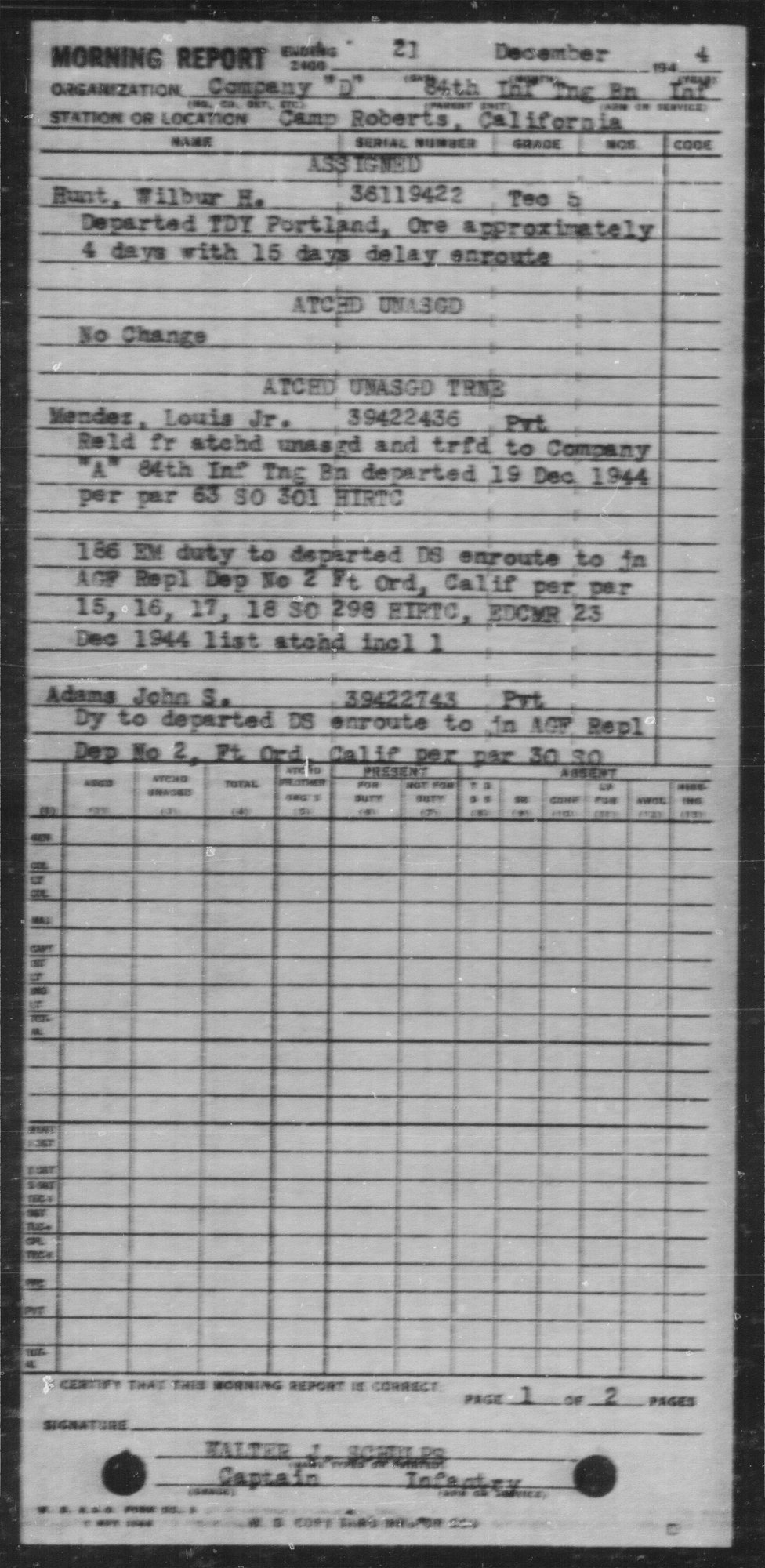
His company’s Morning Report for 21 December moved 186 of its trainees on detached service to Army Ground Forces Replacement Depot No. 2, Fort Ord, California. The authority is paragraphs 15 through 18 of Special Orders No. 298, the same paragraphs that head the 14 December list with his name at line 136, and the report says that list is attached. The entry adds “with delay enroute,” the Army’s term for leave taken while travelling to a new station. The report of 23 December released the 186 men from the company. It names none of them. His place in the group comes from the attached list, and the records do not show the day he reached Fort Ord.
scanned record
Company D’s report for 21 December 1944. The entry for the 186 trainees is in the lower half of the typed section.
Source: Morning Report — Company D, 84th Infantry Training Battalion, IRTC, Camp Roberts — NARA Roll 288 (NAID 578009449), image 1300 (21 December 1944; the 23 December report is image 1308)
Confirmed — Discharge
January 25, 1945

Sailed for the Pacific

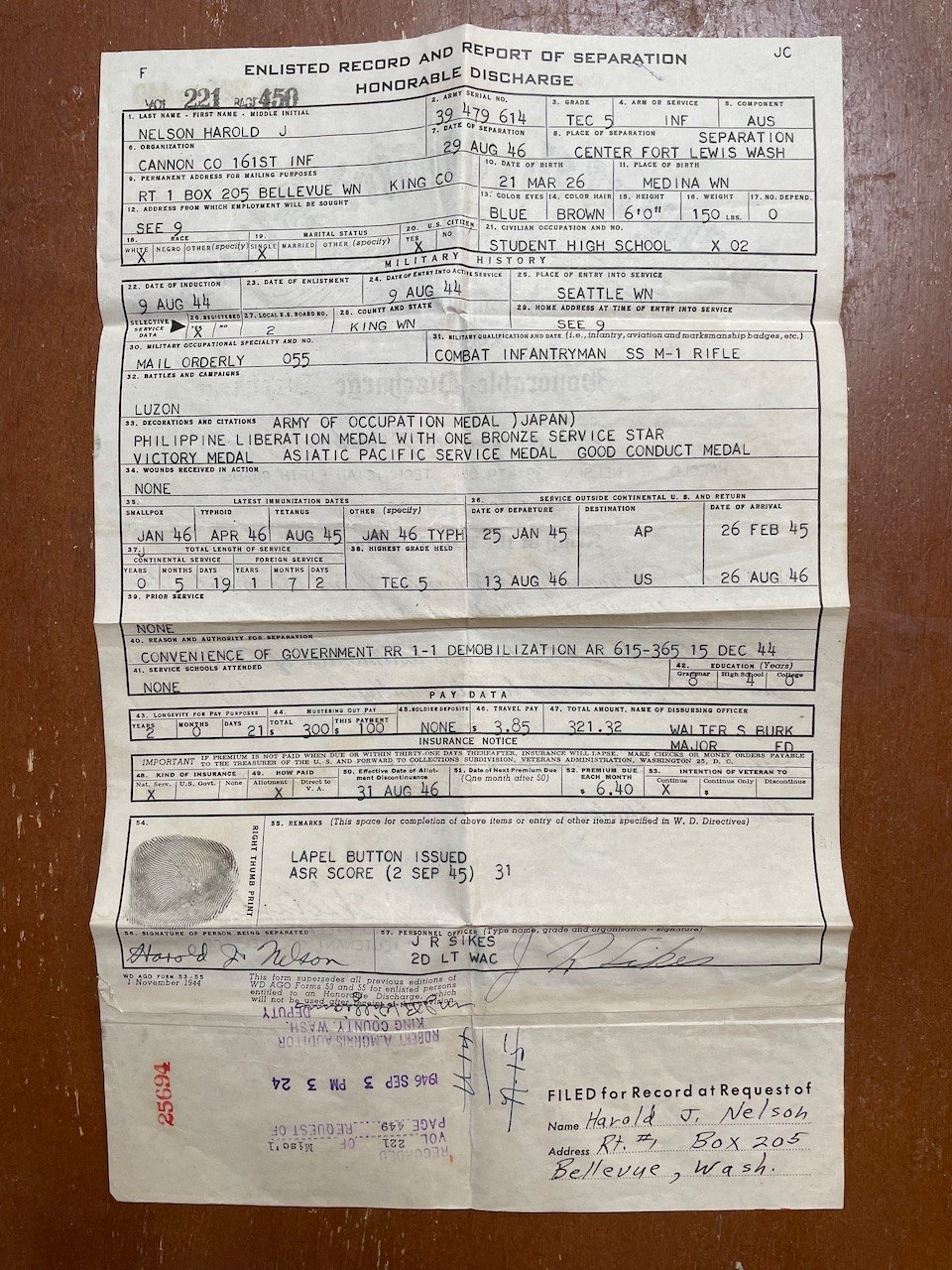
Item 36 of his discharge records the two ocean crossings of his war, and this is the first of them. He left the United States on 25 January 1945, after five months and nineteen days of service at home, by the form’s count. Everything after this date he served overseas.
scanned record
His discharge. Item 36, at the middle right, carries both crossings: out on 25 January 1945, home on 26 August 1946.
Source: Honorable Discharge (WD AGO Form 53-55), item 36 — service outside the continental United States
Confirmed — Discharge
February 26, 1945

Arrived in the Asiatic-Pacific theater

The crossing took thirty-two days. His discharge gives the date of arrival as 26 February 1945 and the destination in the Army’s two-letter shorthand, AP, for Asiatic-Pacific. He was eighteen years old and ten weeks out of infantry training. Five weeks later the Army would date his entry into ground combat.
Source: Honorable Discharge (WD AGO Form 53-55), item 36
Context
February 21 – May 13, 1945

What his regiment was doing — the fight for Balete Pass

Cannon Company belonged to the 161st Infantry Regiment, and through the spring of 1945 the regiment fought north through the ridges west of Route 5 toward Balete Pass, the gateway to the Cagayan Valley. The Army's own history dates the fight from 21 February, when a battalion of the 161st was in contact with Japanese outposts south of Puncan, to 13 May, when the road through the pass was finally opened. Norton's Knob fell to the regiment on 28 March; Crump Hill on 8 April; Highley Ridge was secured by 28 April; and on 4 May a patrol from Company L reached Haruna Ridge, five hundred yards west of the pass itself. Those eighty-two days cost the three regiments of the 25th Division nearly 2,200 battle casualties, 735 of them in the 161st Infantry — 170 men killed and 565 wounded. One detail from the official history's own footnote is worth knowing: Norton, Crump, Highley and Murphree — the hills, the ridge and the river — are all named after men of the 161st Infantry. One detail about his own company: on Luzon the 161st’s Cannon Company fought its 105mm howitzers from M7 self-propelled mounts rather than towed guns — the official history has them in January 1945 with “Cannon Company M7’s… in close support,” and again at Norton’s Knob and Crump Hill in March and April. This card describes his regiment, not Harold personally.
Confirmed — Unit record
April 1, 1945

In ground combat on Luzon

His Combat Infantryman Badge was awarded retroactive to 1 April 1945. The badge marked satisfactory performance of duty in ground combat against the enemy, and the order gives the grounds in its own words: men “whose performance of duty in ground combat against the Japanese Forces on Luzon, Philippine Islands, while serving as assigned members of this regiment was satisfactory or better.” The order does not say when he first saw combat. 1 April 1945 is the earliest date in any record we have found that is tied to his combat service.
Confirmed — Campaign credit
December 15, 1944 – July 4, 1945

Luzon campaign

Earned battle-star credit for the Luzon campaign. Those are the War Department's official dates for the campaign as a whole. Harold reached the theater on 26 February 1945 and was in the fighting by 1 April.
Source: Campaign credit — Honorable Discharge (WD AGO Form 53-55)
Confirmed — Unit record
April 26, 1945

Cannon Company, 161st Infantry Regiment, 25th Infantry Division

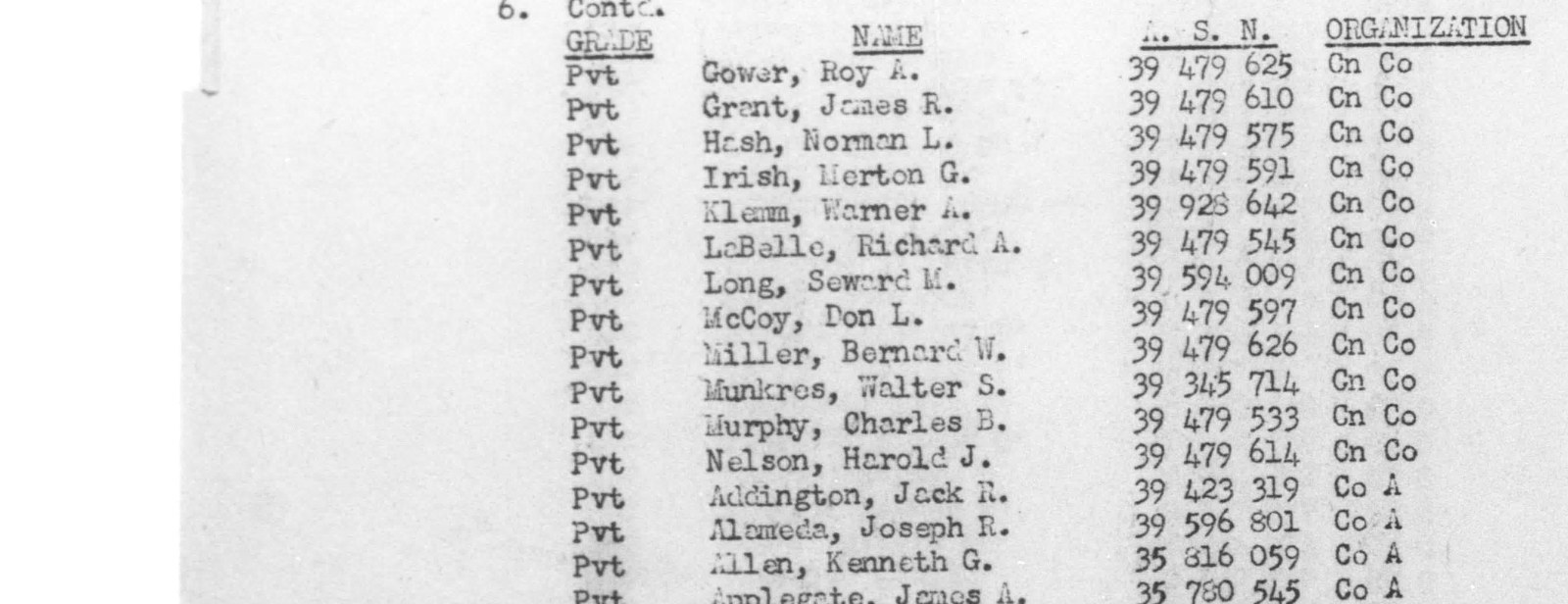
The order awarding his Combat Infantryman Badge also, finally, says what company he was in. On the typed roster, under Cn Co — Cannon Company — is the line “Pvt Nelson, Harold J. — 39 479 614 — Cn Co”. Three men from his 9 August Fort Lewis list are also on this page, in Cannon Company: James R. Grant (39 479 610), Roy A. Gower (39 479 625) and Bernard W. Miller (39 479 626). A fourth, Charles B. Murphy (39 479 533), is there too; the Army sent him to Camp Roberts on the same order as Harold. Eight and a half months after they were inducted, and more than six thousand miles from home, men from his induction group were in his company. The records do not show whether they were together the whole way. The order proves Harold's assignment to Cannon Company, but it does not identify his duty, weapon, section or crew.
scanned record
His line on the award roster: Pvt Nelson, Harold J., 39 479 614, Cn Co. The yellow is ours — it marks his name and service number on the sheet.
Confirmed — Discharge
1945 – 1946

Occupation duty in Japan — the company's mail orderly

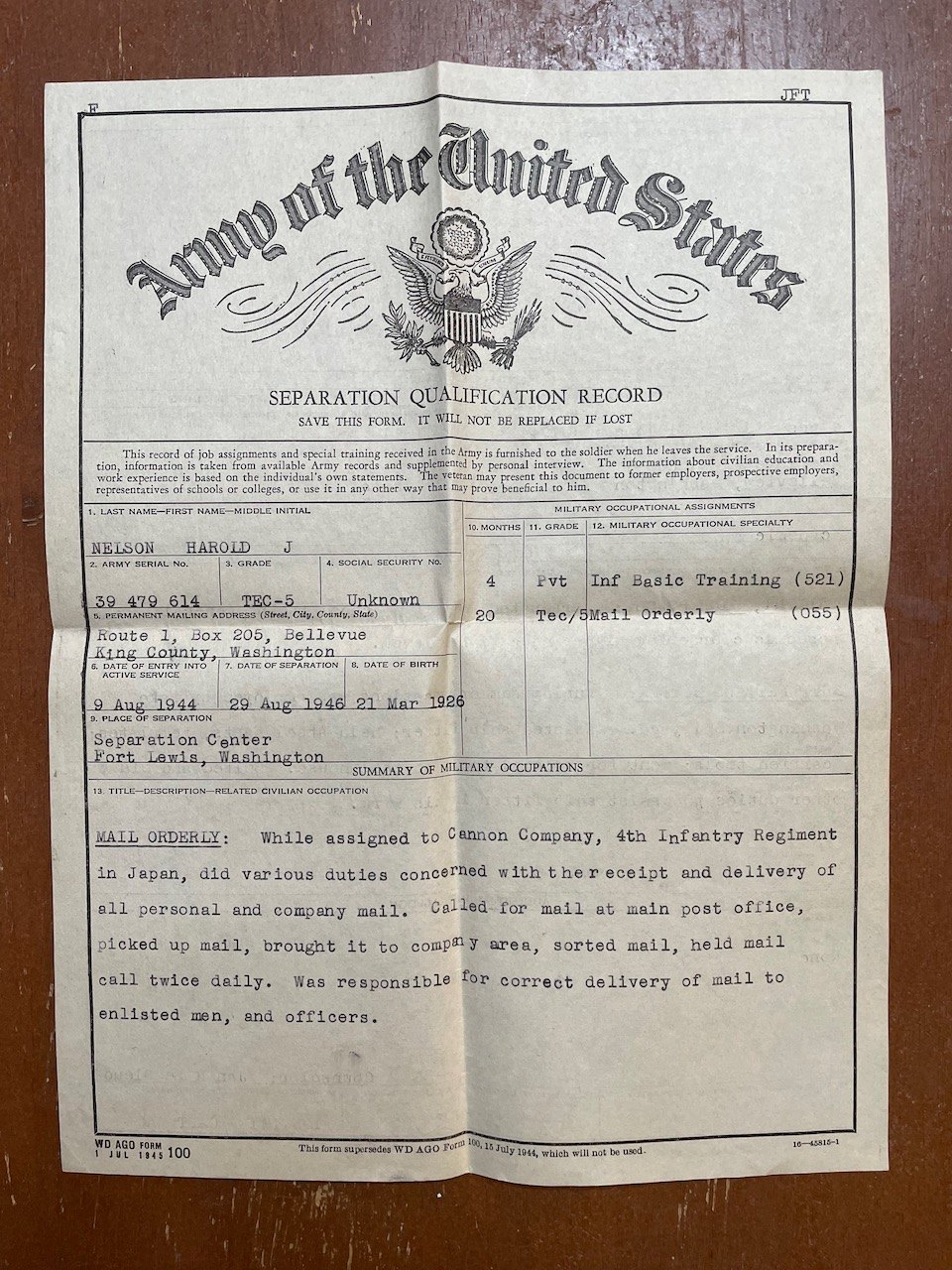
His Separation Qualification Record is the document that says what he did, in prose, and for the last stretch of his service it says he was in Japan. His discharge records the same thing in shorthand: the Army of Occupation Medal with the JAPAN clasp, and a specialty of Mail Orderly, 055. The job is described in his own separation interview: “did various duties concerned with the receipt and delivery of all personal and company mail. Called for mail at main post office, picked up mail, brought it to company area, sorted mail, held mail call twice daily. Was responsible for correct delivery of mail to enlisted men, and officers.” One line on the record needs a word of explanation, because it names a different regiment from his discharge: it says Cannon Company, 4th Infantry Regiment. Harold did not change units; the unit changed its name around him. On 1 November 1945 at Nagoya the 161st Infantry was inactivated and the 4th Infantry’s designation was put in its place — the division’s own history calls it “essentially a redesignation and a change of colors”: the soldiers already in Japan carried on under the 4th Infantry’s name. His discharge, typed in August 1946, still names the 161st. The War Department’s instructions for the form then in force let a man with overseas service list either the overseas unit he served with longest or the one in which he earned the most combat points. The 161st was the regiment he fought with on Luzon; the form does not say which rule the clerk applied. The division had landed at Nagoya in early October 1945, and its headquarters moved to Osaka in January 1946. His own papers give the country, not the town.
scanned record
His Separation Qualification Record. The paragraph at the foot is his job in Japan, in his own separation interview.
scanned record
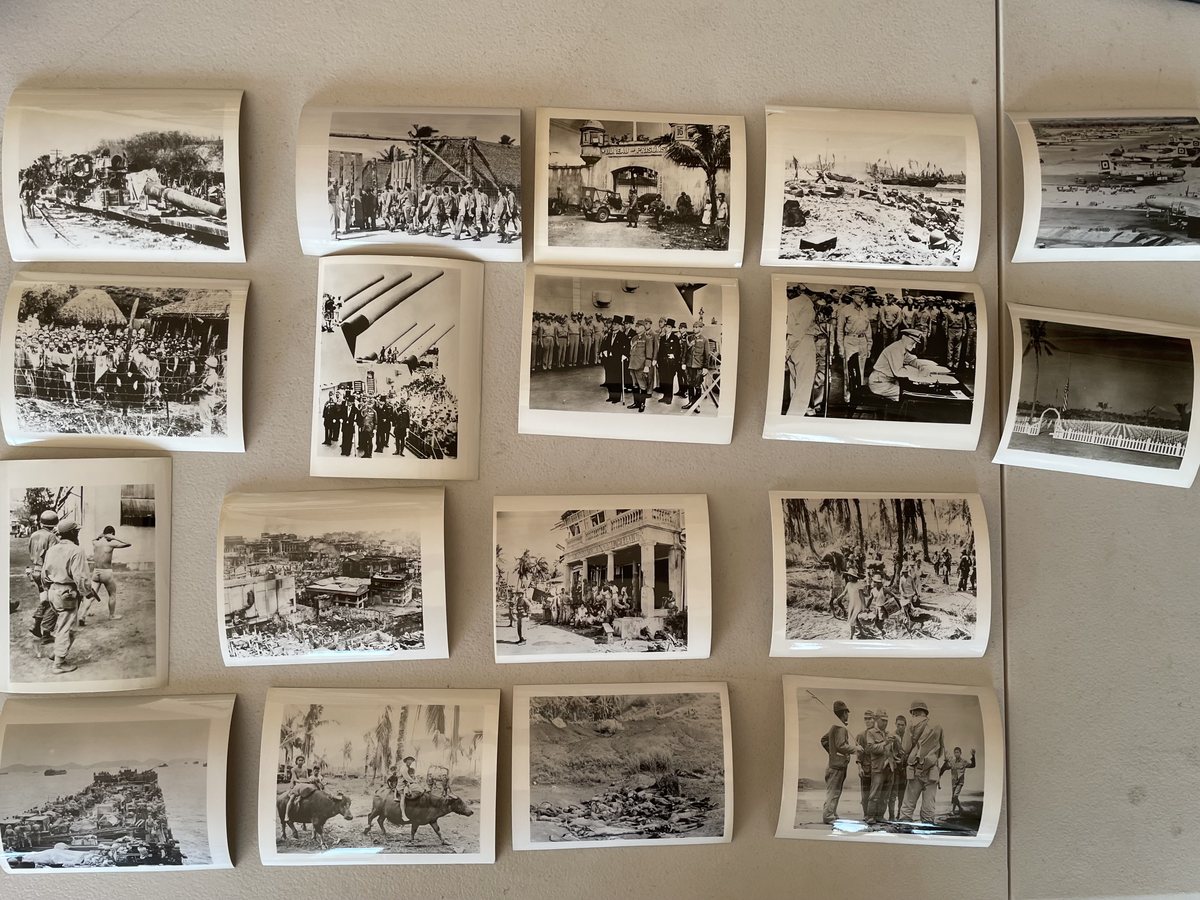
Press photographs of the Philippines and Japan the family preserved — Manila in ruins, the Old Bilibid gate, and the surrender aboard USS Missouri.
Source: Separation Qualification Record (WD AGO Form 100), summary of military occupations; Honorable Discharge (WD AGO Form 53-55), items 6, 30 and 33. The redesignation from 25th Infantry Division Association divisional history, https://www.25thida.org/division/, and Washington State Military Department, history of the 1-161st Infantry, https://mil.wa.gov/history-of-the-1-161st-infantry-battalion. The unit-entry rule from War Department TM 12-236, Preparation of Separation Forms, Changes No. 2, 22 October 1945, item 6, https://www.govinfo.gov/content/pkg/GOVPUB-W-353c0ff3fcb9ab5ebf6a3b10de49f3b6/html/GOVPUB-W-353c0ff3fcb9ab5ebf6a3b10de49f3b6.htm
Confirmed — Discharge
August 13, 1946

Left the theater for home

Eighteen and a half months after he sailed west, Harold started back. His discharge dates his departure from the theater to 13 August 1946 and his arrival in the United States to 26 August 1946. The form totals his time abroad at one year, seven months and two days.
Source: Honorable Discharge (WD AGO Form 53-55), items 36 and 37
Confirmed — Discharge
August 26, 1946

Home

He came back into the United States on 26 August 1946, nineteen months and a day after he had left it.
Source: Honorable Discharge (WD AGO Form 53-55), item 36
Confirmed — Discharge
August 29, 1946

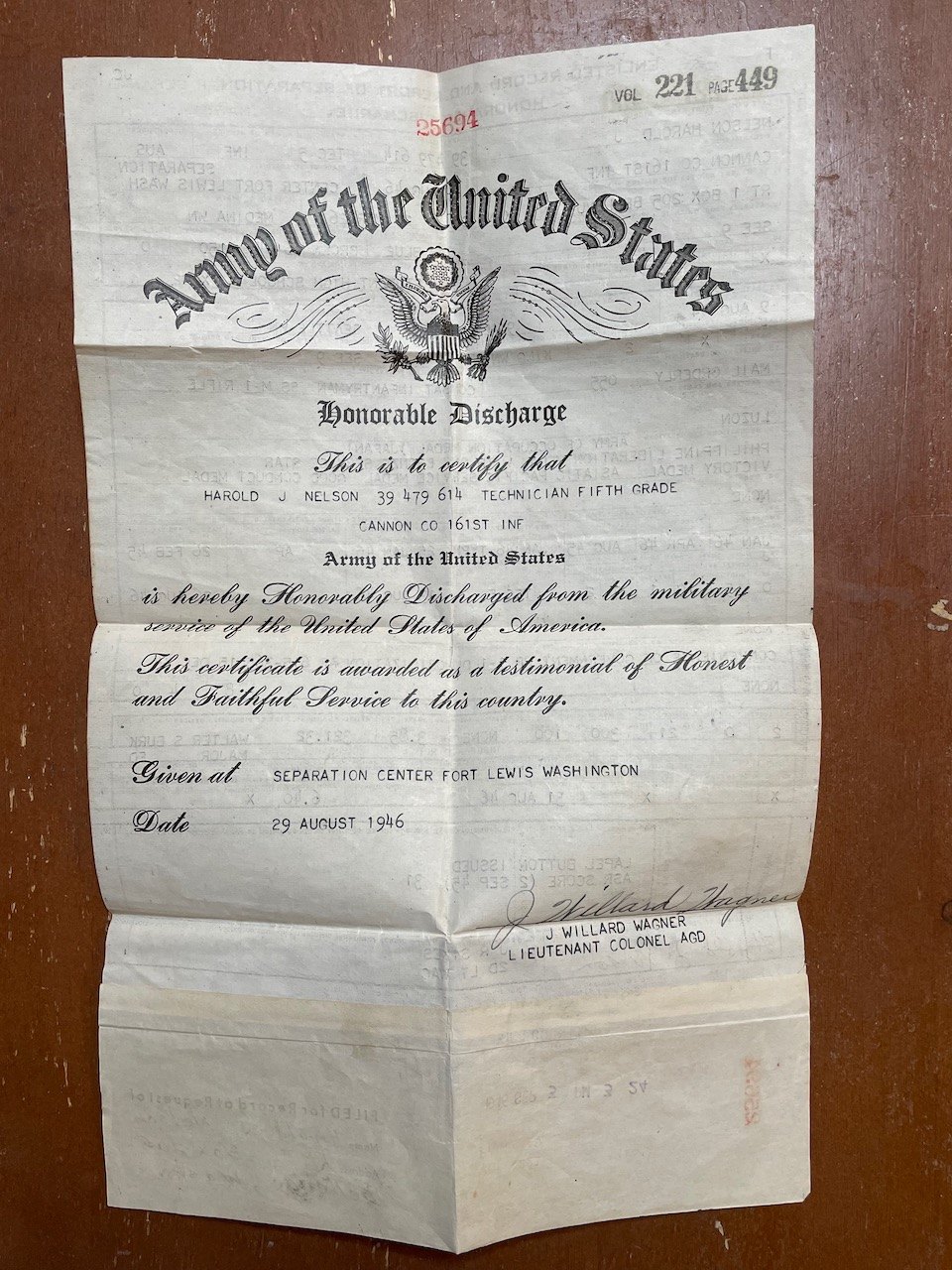
Honorably discharged — Separation Center, Fort Lewis

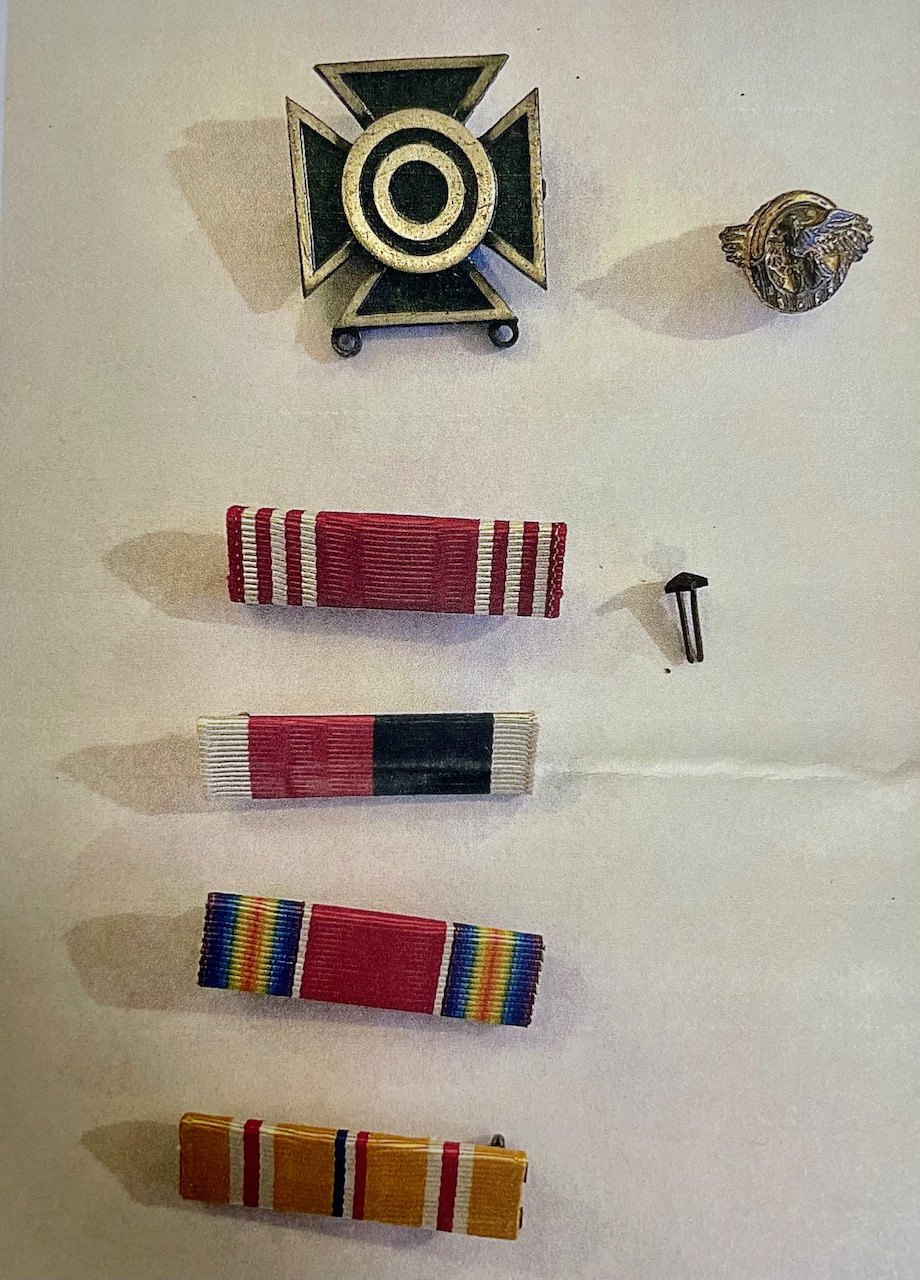
Three days after he arrived back in the United States, Harold was out of the Army. He was discharged at the Separation Center, Fort Lewis, Washington, on 29 August 1946, as a Technician Fifth Grade, from Cannon Company, 161st Infantry. He had served just over two years, and he was twenty years old. His form records six feet tall and a hundred and fifty pounds, blue eyes, brown hair; the first hundred dollars of three hundred dollars of mustering-out pay, and three dollars eighty-five cents of travel pay; and a National Service Life Insurance premium of six dollars forty a month. Against wounds received in action the clerk typed NONE. And against his qualifications: Combat Infantryman — Sharpshooter, M-1 rifle.
scanned record
His Honorable Discharge certificate.
scanned record
His discharge form: height and weight in items 15 and 16, his qualification in item 31, wounds in item 34, mustering-out and travel pay in items 44 and 46, and the insurance premium in item 52.
scanned record
His ribbon bars, the Sharpshooter badge, and an Honorable Service lapel button. His discharge records that a lapel button was issued to him.
Source: Honorable Discharge (WD AGO Form 53-55), and the Honorable Discharge certificate signed by J. Willard Wagner, Lieutenant Colonel, AGD, Separation Center, Fort Lewis, Washington, 29 August 1946
Context
August 29, 1946

Artifacts the family preserves

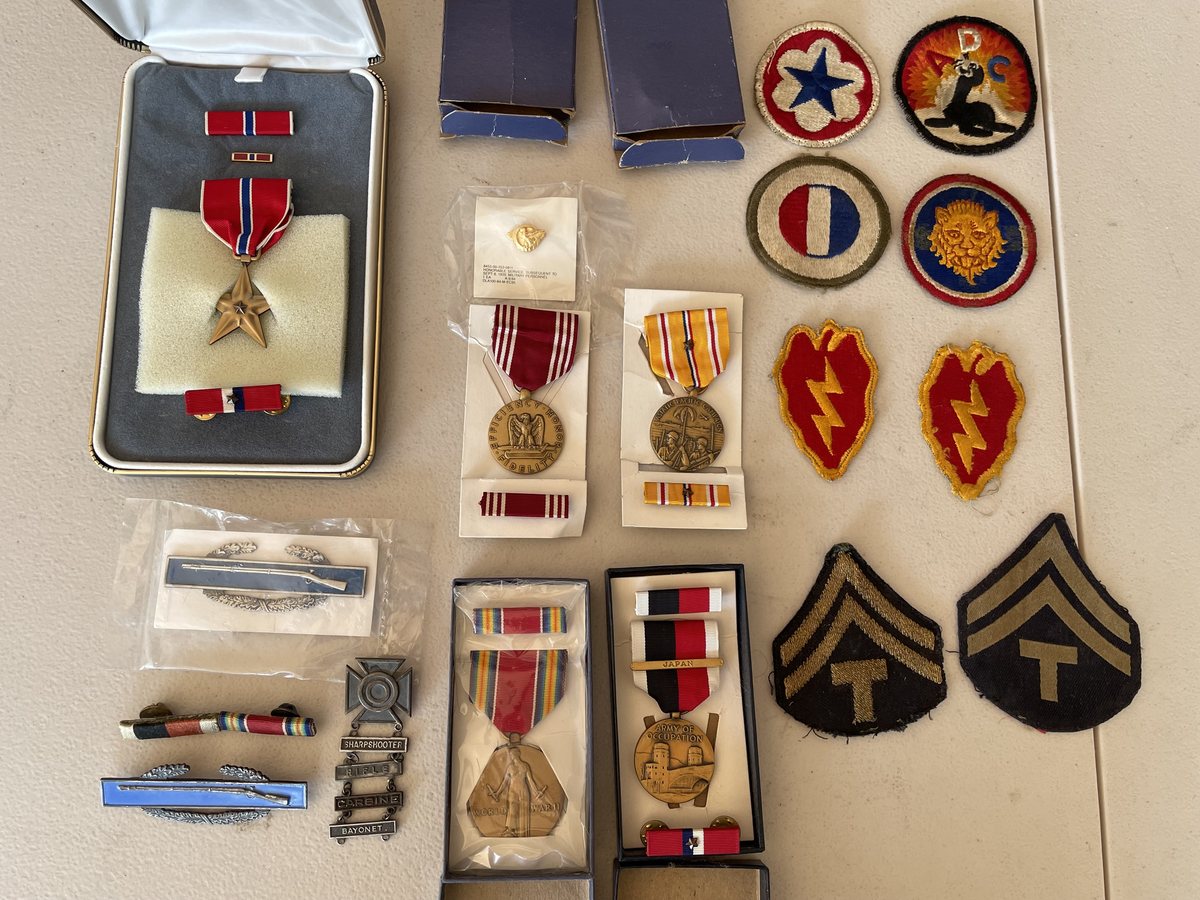
Most of this group matches his discharge. It holds the Good Conduct, Asiatic-Pacific, Victory and Army of Occupation medals, all listed there. The Combat Infantryman Badge and a Sharpshooter badge match his qualifications, and the 25th Infantry Division patches and Technician Fifth Grade chevrons match his division and rank.
scanned record
The medal, badge and insignia group the family attributes to Harold.
Source: Honorable Discharge (WD AGO Form 53-55), items 31 and 33; the medal, badge and insignia group photographed by the family, August 2026
Context
Two men who were there

Voices from his own company and regiment

The Library of Congress preserves the recollections of two men with unusually close connections to Harold’s unit. First Lieutenant Earl R. Swanson served in Cannon Company, 161st Infantry Regiment, 25th Infantry Division on Luzon — Harold’s own company. His collection holds a recorded interview, a memoir and a typed diary; only the interview is online, and it does not describe Luzon. Corporal Mark Dewey Zupan was a draftee in the same regiment, Company L, and trained at Camp Roberts as Harold did before shipping to the Philippines; his collection has been digitized, including an interview, a photo album, memoirs and his own separation paper. Neither man is Harold and neither account mentions him. They are here because they served in his company and his regiment.
Source: Library of Congress, Veterans History Project — Earl R. Swanson Collection, https://www.loc.gov/item/afc2001001.73342/, and Mark Dewey Zupan Collection, https://www.loc.gov/item/afc2001001.24402/
Confirmed — Discharge
September 3, 1946

Files his discharge with King County

Five days after his discharge, the King County Auditor recorded his papers. The stamp reads 3:24 in the afternoon on 3 September 1946, instrument 25694, Volume 221, pages 449 and 450. A handwritten slip at the foot of the sheet gives his name and address: Harold J. Nelson, Rt. #1, Box 205, Bellevue, Wash. Recording a discharge gave a veteran a permanent public copy, which is why his carries a volume and page number.
Source: King County Auditor recording stamps on his WD AGO Form 53-55 (Vol. 221 p. 450) and his Honorable Discharge certificate (Vol. 221 p. 449) — Robert A. Morris, Auditor, King County, Washington, 3 September 1946, instrument 25694
Confirmed — Record
September 6, 1946

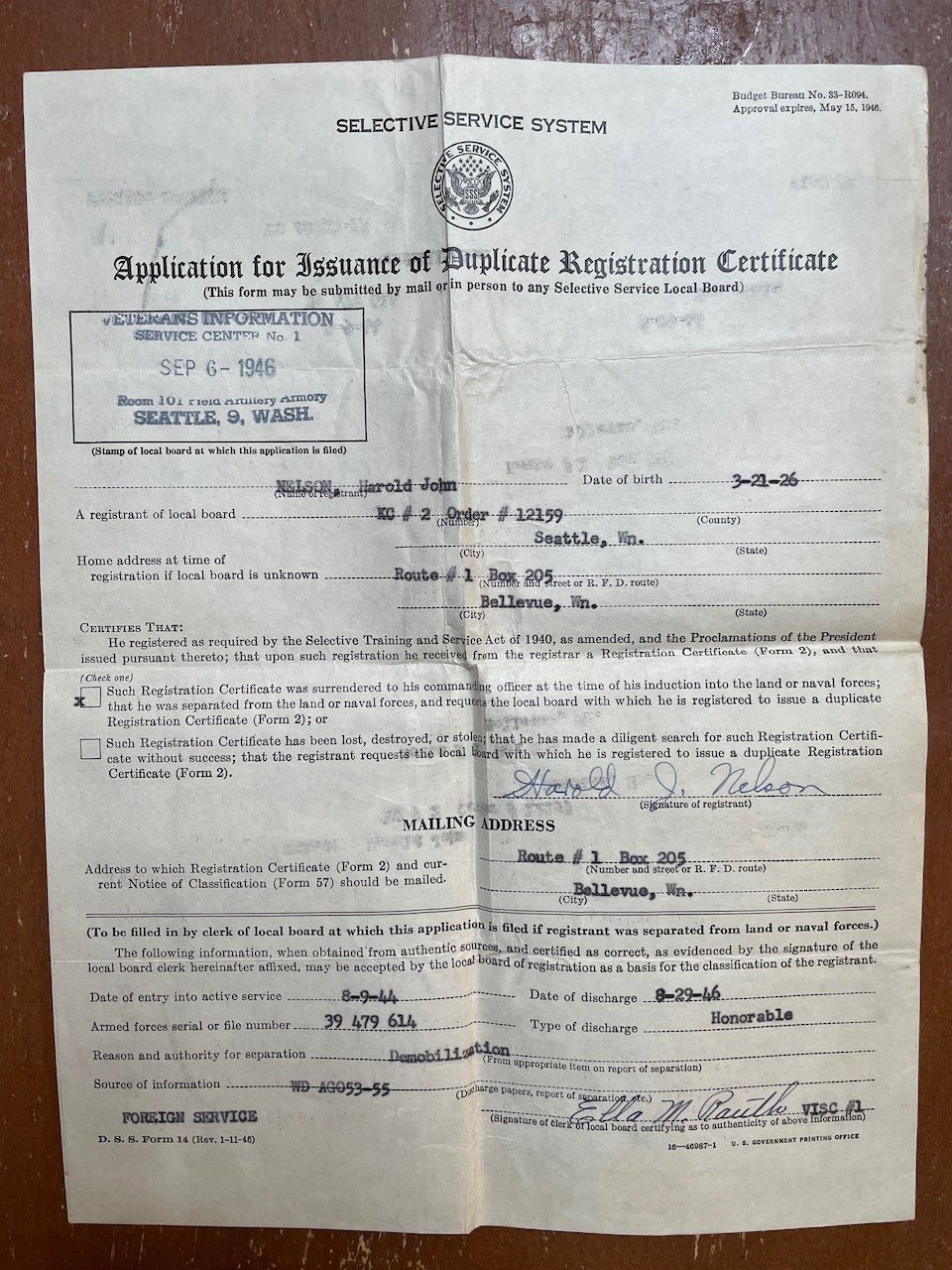
Signs for a replacement draft card

The last of his service paperwork in the family’s collection is a Selective Service form. On 6 September 1946, at the Veterans Information Service Center in the Field Artillery Armory in Seattle, Harold applied for a duplicate Selective Service registration certificate. The box marked on the form says the original was surrendered to his commanding officer at the time of his induction. The form writes his name out in full, Harold John Nelson, and gives his draft board as King County No. 2, order number 12159.
scanned record
His application for a duplicate registration certificate, 6 September 1946.
Source: Selective Service System, D.S.S. Form 14, Application for Issuance of Duplicate Registration Certificate, filed 6 September 1946, Seattle, Washington. Held by the family
Confirmed — Record
April 29, 1950

The 1950 census: at home with his parents

On 29 April 1950 the census enumerator, Eloise P. Clausen, recorded the household on 78th N.E.: Harold and both his parents, together on one page. Nels C. Nelson, his father, was seventy-five, born in Wisconsin, and had worked twenty-four hours the week before as a land clearer. Nina E. Nelson, his mother, was sixty-four, born in Minnesota, keeping house. Harold J. Nelson, twenty-four and never married, had worked forty hours the week before as a riveter in an aircraft factory.
Confirmed — Record
February 21, 1953

Marries Rosanne, in King County

Six and a half years after coming home, Harold married Rosanne H. Stevens in King County. The county's own marriage index gives the date as 21 February 1953. The 1940 census lists her, at fourteen, as Rosanne H. Stevens, stepdaughter in her stepfather’s household; her obituary names her father as Matthew James Stevens. They raised two children, Steven and Susanne, and they are buried together in the same grave.
Source: Washington State Archives, Digital Archives — King County Marriage Records, 1855–2017, reference kingcoarchmc187937, https://digitalarchives.wa.gov/Record/View/A0987731D6127FE5848EF146B7AFFEA0; 1940 U.S. Census, King County, Washington, ED 17-141, sheet 2A, line 29; her father and the children from Rosanne H. Nelson's obituary, Seattle Times, 15 December 2019, https://www.legacy.com/us/obituaries/seattletimes/name/rosanne-nelson-obituary?id=14711427; VA Veterans Legacy Memorial, https://www.vlm.cem.va.gov/HAROLDJNELSON/E81289C (shared gravesite)
Confirmed — Record
February 11, 1998

Harold John Nelson passes away

He died at seventy-one. His last home was in Seattle. His wife, Rosanne H. Nelson, outlived him by twenty-one years and is buried with him in the same grave at Tahoma National Cemetery. This timeline is offered in his memory.
Source: VA BIRLS record; Social Security Death Index; NARA Numerical Identification Files, Death file, https://aad.archives.gov/aad/record-detail.jsp?dt=3003&rid=4940093; Find A Grave memorial #1028940
Confirmed — Record
Tahoma National Cemetery, Kent, Washington

Buried at Tahoma National Cemetery

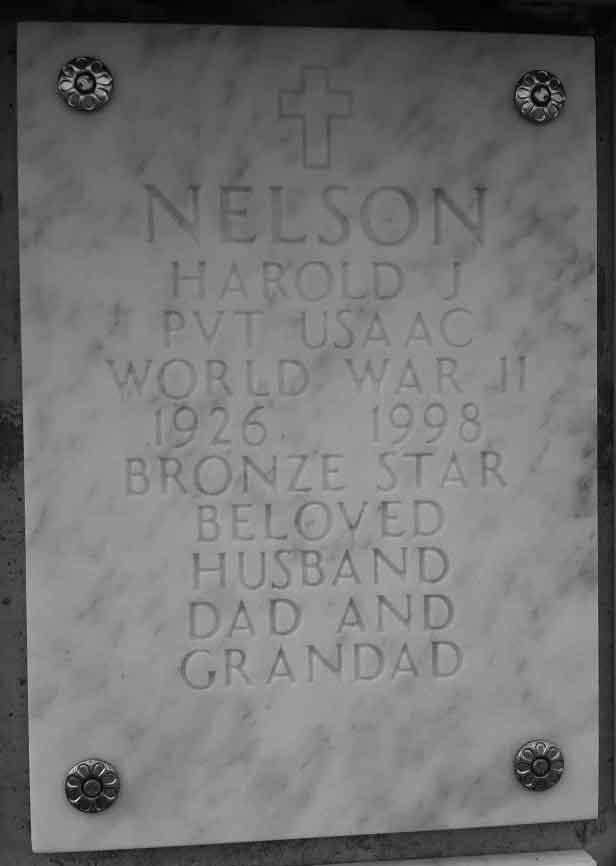
Section J, Row A, Site 23. Harold was buried on 13 March 1998. Tahoma had opened for burials on 1 October 1997, less than six months earlier. His government headstone carries his name, WORLD WAR II, the years 1926 1998, the BRONZE STAR, and the inscription BELOVED HUSBAND DAD AND GRANDAD. It also reads PVT USAAC (Private, U.S. Army Air Corps), which does not match his discharge: Technician Fifth Grade, Infantry. The application for the stone has not been found, so the source of that line is not known. Rosanne rests with him.
scanned record
His headstone at Tahoma National Cemetery, Kent, Washington.
Source: U.S. Department of Veterans Affairs, Veterans Legacy Memorial and National Cemetery Administration gravesite record (interment date 13 March 1998), https://www.vlm.cem.va.gov/HAROLDJNELSON/E81289C; the headstone photographed at the site; the cemetery's opening date from the VA National Cemetery Administration, https://www.cem.va.gov/cems/nchp/tahoma.asp